
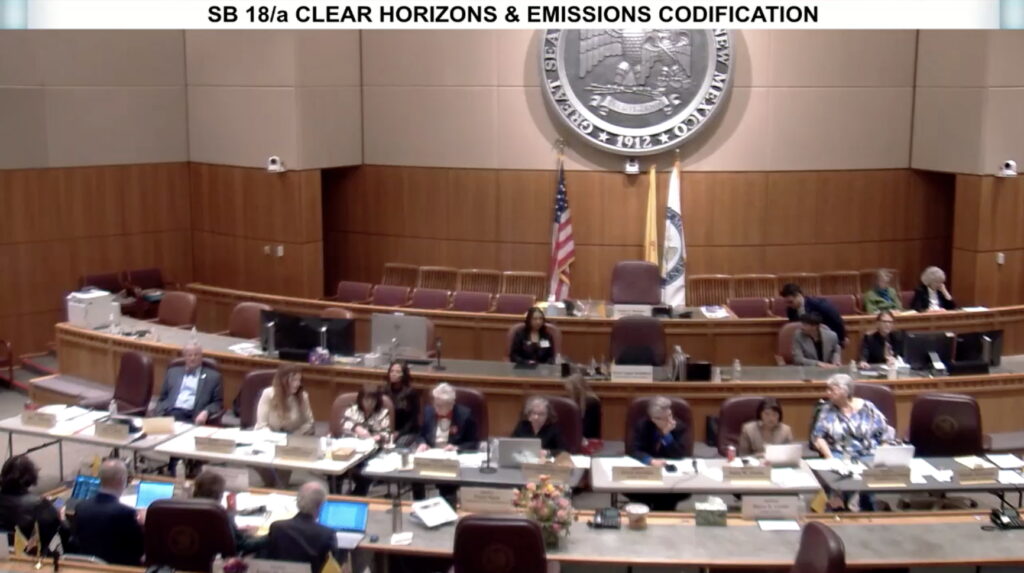
SANTA FE — A contentious proposal to codify New Mexico’s climate goals into state law survived its first legislative hurdle Tuesday, clearing the Senate Conservation Committee despite a fractured vote and warnings of severe economic repercussions.
Senate Bill 18, the Clear Horizons Act, passed the committee on a 5-4 vote. In a notable break from party leadership, Sen. Joseph Cervantes, D-Las Cruces, joined the committee’s three Republicans in opposition, highlighting the deepening divide over the state’s continued attack on fossil fuels.
The legislation seeks to mandate a 45% reduction in greenhouse gas emissions by 2030 and a total 100% reduction—or “net zero”—by 2050, using 2005 levels as a baseline. Sponsored by Senate President Pro Tem Mimi Stewart, D-Albuquerque, the bill aims to turn existing executive orders from Gov. Michelle Lujan Grisham into permanent state statute.
Opposition focused heavily on the potential for staggering financial losses in the San Juan and Permian basins. Tom Clifford, an economic researcher testifying on behalf of the New Mexico Oil and Gas Association (NMOGA), provided a grim fiscal outlook, drawing direct comparisons to other states with similar mandates.
Clifford testified that since California implemented comparable climate policies, its oil and gas production has decreased at a rate of over 6% per year. He further noted that in Colorado, where similar regulations are in place, production has remained essentially flat, growing at less than 1% annually—a sharp contrast to the more than 100% growth New Mexico has experienced in the same timeframe.
With the oil and gas industry currently providing roughly 50% of New Mexico’s total state budget—amounting to approximately $13.1 billion—Clifford warned that even a modest 5% decline in production resulting from SB 18 could drain the state budget by $12 billion by 2050—nearly half of the current state budget. Such a shortfall, he argued, would directly threaten the primary funding source for public schools and infrastructure statewide.
Matthew Gonzales, vice president of state affairs for the Consumer Energy Alliance, argued that the bill lacks necessary safeguards for energy affordability and grid reliability. He suggested the mandates would place an undue burden on New Mexico families already struggling with inflation.
Agricultural leaders joined the chorus of opposition, expressing fear that the net-zero requirement would eventually cripple the state’s ranching industry. Dustin Johnson, a rancher representing the New Mexico Cattle Growers’ Association, told the committee that a 100% reduction mandate is operationally impossible for livestock producers and threatens the survival of rural communities.
Republican lawmakers echoed these concerns, questioning the feasibility of the targets. Sen. Candy Spence Ezzell, R-Roswell, characterized the zero-emissions goal as “ludicrous and scientifically impossible,” warning that industry leaders would likely relocate their operations to more business-friendly states.
Sen. Jim Townsend, R-Artesia, questioned how the state would replace the massive revenue streams generated by the energy sector in southeast New Mexico. He characterized the bill as a direct threat to the economic engine of the state.
Despite the pushback, proponents argued that the cost of inaction is higher. New Mexico Environment Secretary James Kenney testified that failing to address climate change “could” cost the state billions by 2050 due to health impacts and extreme weather damage.
The bill now moves to the Senate Tax, Business, and Transportation Committee, where it is expected to face further scrutiny regarding its long-term fiscal impact on the state.