
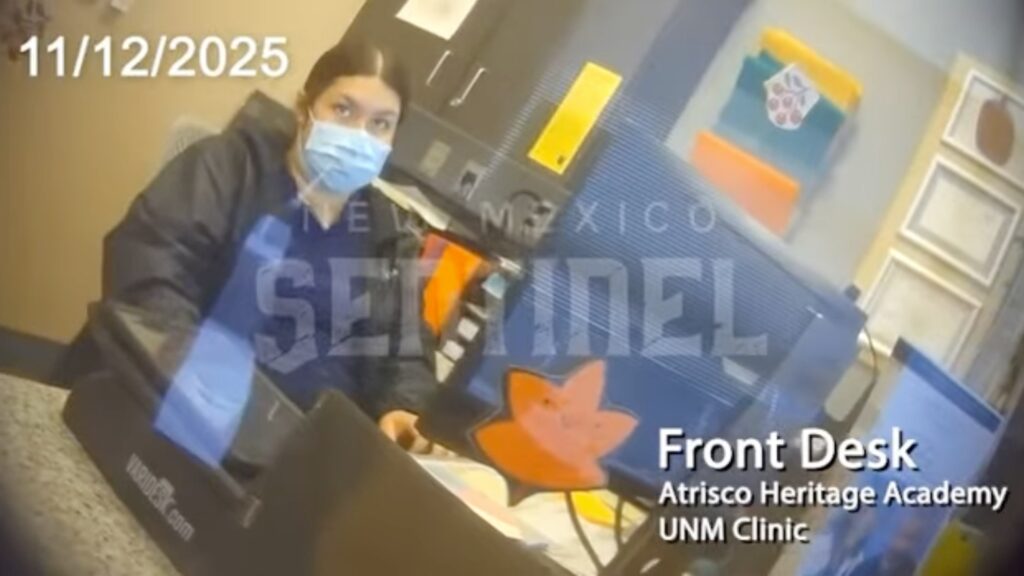
ALBUQUERQUE — Staff at Atrisco Heritage Academy and its on-campus University of New Mexico health clinic described access to gender-affirming care, including referrals to specialized clinics and the potential for some treatments to be prescribed locally, according to undercover video obtained by the New Mexico Sentinel.
The footage is part of the Sentinel’s ongoing investigative series examining how minors in New Mexico access sensitive medical services.
In the recording, clinic staff explain that while Atrisco Heritage does not host a dedicated gender-affirming care clinic, students have access to providers who can begin aspects of care and connect them to additional services within the UNM system.
“This is a UNM clinic,” a clinic director said. “We don’t have that specific clinic here, but we do have providers that can do that.”
Staff pointed to UNM’s “Deseo” clinics — specialized programs offering gender-affirming care — as primary referral locations, describing services available through sites in Southeast Heights and North Valley.
Those clinics include a range of providers, including physicians and a pediatric endocrinologist who treats minors and adults.
“They make sure that they have, like, the access to any type of, like, counseling that they might need,” the director said.
The conversation also addressed specific treatments, including hormone therapy and puberty blockers.
Clinic staff indicated that hormone therapy could be prescribed, while noting some uncertainty about the availability and routine use of puberty-blocking medications such as Lupron.
“We could prescribe the hormones,” the director said, adding that access to certain medications may depend on provider experience and coordination with other clinics.
The director said that even if services are not provided directly at the school-based clinic, patients would be connected to other providers within the UNM system.
“If it’s not here, it’ll be somewhere else,” the director said.
The recording also suggests that patients have traveled from out of state to access care in New Mexico.
“We did see a lot of kiddos coming over from Texas,” the director said.
The video does not specify what parental notification or consent requirements may apply for gender-affirming medical treatment, including hormone therapy or puberty blockers.
Medical guidelines for gender-affirming care typically involve multiple stages of evaluation, including mental health assessment and specialist oversight, though implementation may vary by provider.
New Mexico law explicitly allows minors to consent to certain categories of care, including behavioral health services, but does not comprehensively outline all aspects of gender-affirming medical treatment in statute.
This report builds on earlier Sentinel investigations into abortion access and cross-state care coordination involving minors.