
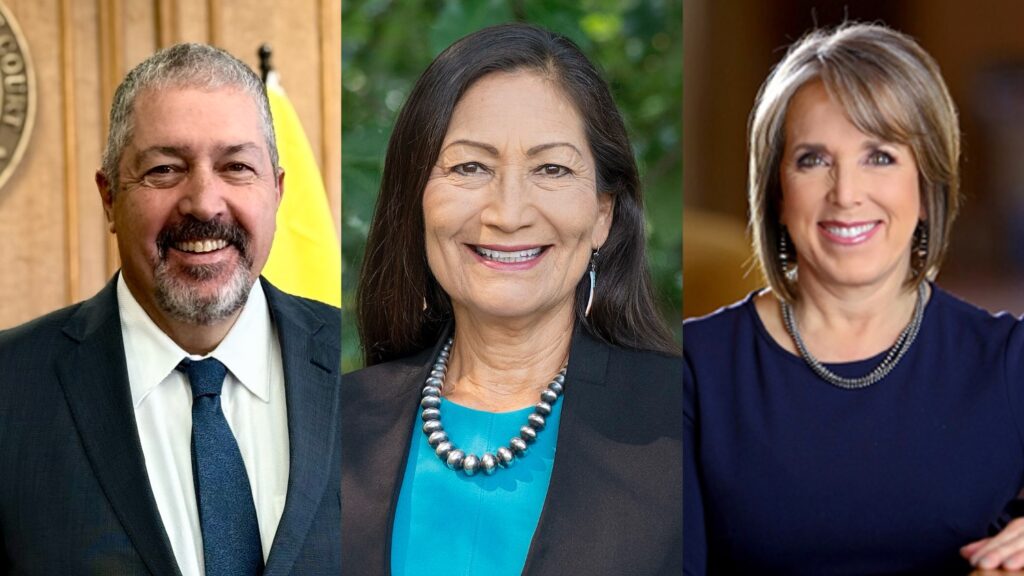
ALBUQUERQUE — With just over a month until New Mexico’s June primary election, former U.S. Interior Secretary Deb Haaland holds a sizable lead in the Democratic race for governor, though a significant share of voters remain undecided, according to a new KRQE/Emerson College Polling survey.
The poll found Haaland with 40% support among likely Democratic primary voters, compared with 24% for Bernalillo County District Attorney Sam Bregman. About 36% of respondents said they were undecided, highlighting continued uncertainty in the race despite the approaching primary.
The survey offers a snapshot of voter sentiment in New Mexico, where Democrats are competing to succeed term-limited Gov. Michelle Lujan Grisham. While Haaland maintains a double-digit advantage, the large bloc of undecided voters suggests the race could still shift in the final weeks of campaigning.
On the Republican side, the contest remains even more unsettled. Rio Rancho Mayor Greggory Hull leads with 21%, followed by businessman Duke Rodriguez at 10% and small business owner Doug Turner at 9%. A majority of Republican primary voters — 61% — said they are undecided, indicating no clear front-runner has emerged as the primary nears.
The poll also identifies the issues most important to voters heading into the election. Healthcare and the economy were tied as the top concerns, each cited by 23% of respondents. Crime followed at 17%, with education at 12% and housing at 9%.
Voter sentiment on safety appears to be a notable factor. Half of those surveyed said they feel less safe than they did a year ago, while 13% said they feel safer.
The survey also measured approval ratings for political leaders. President Donald Trump received 37% approval and 56% disapproval among New Mexico respondents. Gov. Lujan Grisham’s ratings were more closely divided, with 40% approving and 42% disapproving of her performance.
Nearly half of respondents — 49% — said they disapprove of how the state’s Children, Youth and Families Department is being run. About 46% support changing how the agency’s leadership is appointed, signaling potential public interest in reforms.