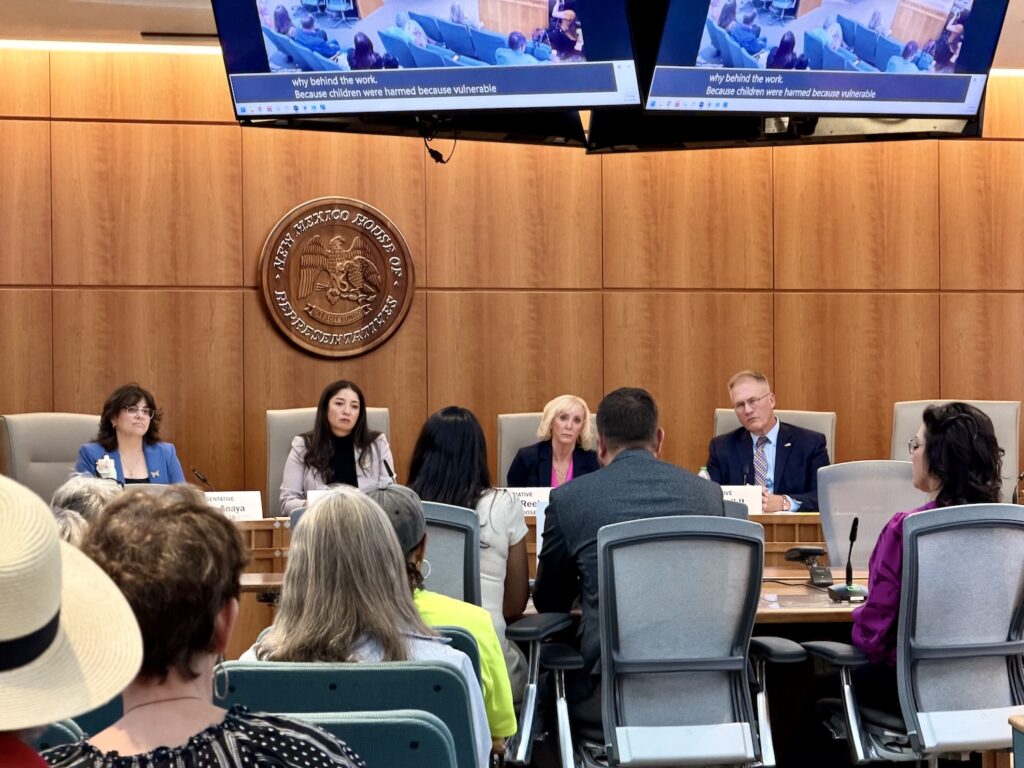
SANTA FE — New Mexico’s bipartisan Epstein Truth Commission convened its first public meeting Monday at the state Capitol, hearing emotional testimony from survivors, announcing 14 institutional subpoenas and outlining an investigative scope that commission members called historic. The meeting lasted less than an hour.
The News
The four-member panel — created in February by House Resolution 1 and operating on a $2 million budget drawn from settlement funds with Epstein’s banks — heard from two survivors before laying out its work plan.
Rep. Andrea Romero, D-Santa Fe, who chairs the commission, said the body is now “actively developing and following through on investigative procedures, reviewing available materials, engaging subject-matter experts, and preparing for public hearings and testimony intake.”
The only known Epstein survivor living in New Mexico, identified publicly only as Rachel, testified about her experiences. The commission also heard from Sky Roberts and Amanda Roberts, the brother and sister-in-law of Virginia Roberts Giuffre, the prominent Epstein accuser who died by suicide in April 2025.
“Virginia was not only abused by Jeffrey Epstein and Ghislaine Maxwell,” Sky Roberts told the commission. “She was trafficked to extremely wealthy, powerful and dangerous individuals. Some of that trafficking happened right here in New Mexico at Zorro Ranch. That is not speculation. That is not rumor. That is testimony.”
At the close of the meeting, Romero signed 14 subpoenas targeting institutions with known or alleged ties to Epstein.
“Today this commission makes history,” Romero said. “We’re issuing the first subpoenas ever to be issued by the New Mexico state legislature. This power has always been available to us but now we are exercising it in full — in the service of the survivors and the rule of law.”
The subpoena recipients are: the Estate of Jeffrey Epstein; the FBI; the U.S. Department of Justice; the U.S. Attorney’s Office for the District of New Mexico; the U.S. Attorney’s Office for the Southern District of New York; the Federal Aviation Administration; Deutsche Bank; JP Morgan Chase & Co.; the New Mexico Department of Public Safety; the New Mexico Department of Justice; the Office of the Governor of New Mexico; the New Mexico State Land Commissioner; the Santa Fe County Sheriff’s Department; and the Santa Fe Institute. Notably, the subpoenas are directed at institutions and entities — not at named individuals.
The commission has retained Albuquerque-based personal injury law firm Fadduol, Cluff, Hardy & Conaway for legal and investigative support. It plans to release an interim report to House leadership by July 31 and a final report to all House members by Dec. 31. Rep. Andrea Reeb, R-Clovis, told Scripps News there is a possibility the commission will need additional resources before the final report is completed.
Commission members also addressed the looming question of former Democratic Gov. Bill Richardson, who died in 2023. Romero said the commission has not yet sought cooperation from Richardson’s estate but would “go as far as needed.” U.S. Department of Justice files released earlier this year appear to contradict Richardson’s spokesperson’s 2019 claim that he visited Zorro Ranch only once, in 2012.
The Questions Other Outlets Didn’t Ask
What the coverage of Monday’s meeting largely omitted is what the commission cannot do — and who built it.
Start with the subpoenas themselves. While Romero called their issuance historic, the 14 orders target organizations, not individuals. More significantly, the enforcement mechanism built into HR 1 runs through the district court once the legislature adjourns — meaning any resistant recipient can litigate compliance on their own timeline.
That presents a particular problem for the federal targets on the list. The FBI, the U.S. Department of Justice and both U.S. Attorney’s offices operate under federal sovereign immunity principles that give them substantial latitude to decline or delay compliance with a state legislative subpoena. The commission has no mechanism to compel federal cooperation and no referral pathway to a federal grand jury.
The commission’s own enabling document anticipated this risk. The fiscal impact report prepared by the Legislative Finance Committee and reviewed by the Attorney General’s office noted that the Legislature’s general power to investigate is real but cautioned that the commission “would have to take care when investigating whether identifiable individuals committed crimes or stating that identifiable individuals committed crimes” — citing the state constitution’s prohibition on bills of attainder and the due process rights of any person the commission might name.
The commission has no prosecutorial authority and cannot refer findings to a grand jury.
There is also the question of what the commission is not: a joint body. HR 1 is a House-only resolution, passed without Senate involvement. That structure means the commission cannot compel a state senator to testify, cannot access Senate records and carries no cross-chamber authority.
The legislature’s most powerful investigative vehicle — a joint interim committee with full statutory subpoena power enforceable under Chapter 2 of the NMSA — was never pursued. No explanation has been offered publicly for why.
Then there is the chair’s record. Romero has made the failure to require Epstein to register as a sex offender in New Mexico a centerpiece of the commission’s preliminary policy agenda. What she has not addressed publicly is her own vote on that precise issue.
In January 2020, House Bill 43 — legislation that would have required out-of-state sex offenders physically present in New Mexico for more than 10 days to register — was referred to the House Consumer and Public Affairs Committee. According to legislative records, Romero, then a committee member, voted with fellow Democrats to table the measure on Jan. 28, 2020.
The bill died without a committee report or floor vote. The loophole it would have closed is the same one that allowed Epstein to spend extended periods at Zorro Ranch unregistered. No other outlet has reported this.
The commission’s political calendar is also worth scrutiny. Romero traveled to Washington, D.C., four days after the February formation vote as the guest of U.S. Rep. Melanie Stansbury, D-New Mexico, at the State of the Union, where Epstein survivors attended as guests of more than a dozen members of Congress. The commission’s July 31 interim report deadline lands squarely in the heart of New Mexico’s 2026 primary and general election season.
Whether that timeline reflects investigative necessity or political convenience is a question the commission has not addressed.
What It Can Do
None of that forecloses the commission from producing meaningful work. Survivor testimony on a public, official record has value independent of any prosecutorial outcome.
Legislative recommendations on New Mexico’s statute of limitations for childhood sexual assault, gaps in the sex offender registry, shell company transparency — raised by Rep. Marianna Anaya, D-Albuquerque, at the February meeting — and the stewardship of Epstein-linked settlement funds are all legitimate reform targets within the commission’s scope. The NMDOJ’s parallel criminal investigation, reopened earlier this year, operates on a separate track with actual prosecutorial authority.
The commission may yet produce a record that matters. But the gap between what was announced Monday and what the commission can actually compel, prosecute or prevent is wider than the headlines suggest — and wider than its chair has acknowledged.