
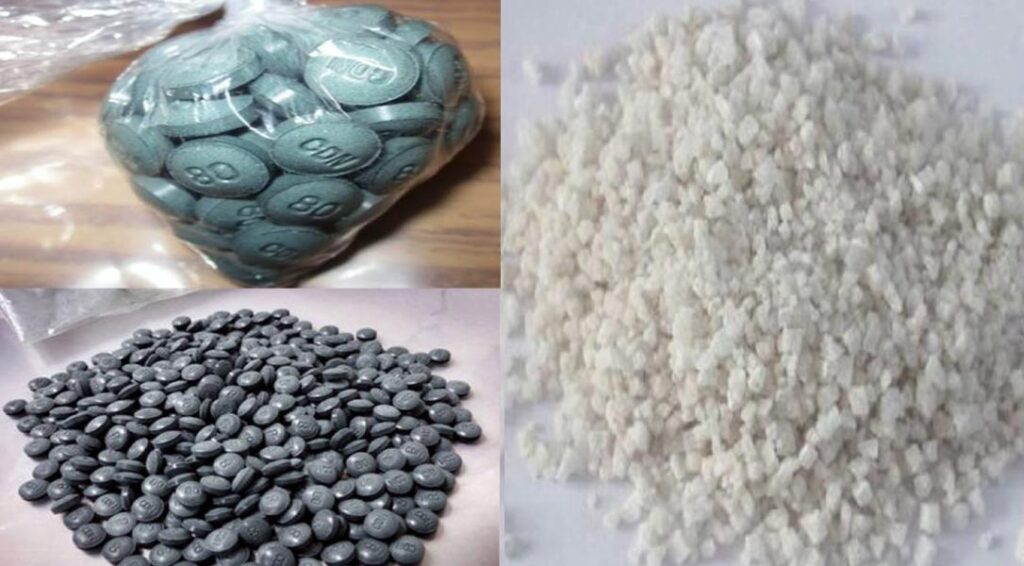
ALBUQUERQUE — The Drug Enforcement Administration repeatedly monitored fentanyl shipments in New Mexico between 2023 and 2025 and allowed the pills to reach street-level dealers without intervention — a strategy meant to build larger federal prosecutions — according to a bombshell investigation published Monday by the Associated Press.
The AP, which reviewed hundreds of internal DEA records and interviewed three current and former agents, found that DEA agents permitted hundreds of thousands of fentanyl pills to flow into New Mexico communities while federal prosecutors pursued what they called bigger criminal cases against trafficking networks.
The investigation centers on DEA Special Agent David Howell, a 19-year veteran who grew alarmed at the tactic and began documenting its potential consequences. In one instance in June 2023, agents deciphered coded cellphone communications and closely surveilled a drug deal at an Albuquerque mobile home park, documenting that traffickers delivered 74,000 pills — a figure later confirmed by federal prosecutors in a court filing — while taking no action to stop it. Days earlier, agents from the same investigation watched the same distribution ring deliver a spare tire concealing another suspected fentanyl shipment, which also went unseized.
“We did nothing but sit back and watch,” Howell told the AP. He filed a formal whistleblower complaint in late 2023, reporting that agents had observed — yet not seized — separate deliveries of 150,000 and 50,000 fentanyl pills.
The potential human cost looms over every pill count. Howell began flagging overdose deaths he believed may have been caused by the very pills DEA permitted to flow to dealers. Among them: a 15-month-old toddler who died after ingesting burned fentanyl residue in Española. Howell warned federal prosecutors, according to the AP, that authorities were placing themselves in a position where they could not prove the unseized fentanyl had not killed someone.
The scale grew dramatically over the life of one multi-year investigation. A former DEA supervisor, speaking on condition of anonymity, said agents allowed “millions” of pills to go unseized during a multi-state case. Howell’s whistleblower disclosures put the figure at a minimum of 1.8 million fentanyl pills. That investigation ultimately produced what the DEA announced in May 2025 as the largest fentanyl bust in its history — a takedown resulting in the seizure of more than 3 million pills. “The amount we ultimately seized was hitting the streets every month while that case was going on,” the former supervisor said, adding that the DEA could have dismantled the organization six months earlier.
The revelations land at a moment when New Mexico bears a disproportionate share of the national overdose burden. While overdose deaths nationally fell 14% last year, New Mexico recorded a 21% spike.
The man whose prosecutorial decisions are now under scrutiny is no stranger to New Mexico’s political landscape. Alex Uballez served as U.S. attorney for New Mexico from 2022 until early 2025, when he was removed at President Donald Trump’s request. He then parlayed his profile into a 2025 run for Albuquerque mayor — campaigning on a progressive platform centered on protecting immigrants and combating income inequality and positioning himself explicitly to the left of incumbent Mayor Tim Keller, arguing Keller had not done enough to protect undocumented immigrants and had failed to address homelessness compassionately. He finished third in November with 18.7% of the vote, behind Keller and former Bernalillo County Sheriff Darren White, and did not advance to the December runoff.
Uballez defended the DEA’s approach in the AP report. He said the strategy of allowing some shipments to go unseized reflected his office’s limited resources and his belief that dismantling larger trafficking organizations ultimately saves more lives than intercepting individual transactions. “The bigger fish are worth catching,” he said.
The Justice Department’s Office of Professional Responsibility concluded in 2024 that both the DEA and the U.S. attorney’s office had made reasonable decisions in allowing the drugs to go unseized and that their inaction posed no specific danger to public health. Meanwhile, even as Howell’s complaint was under review, DOJ rewrote internal rules to give law enforcement broader discretion in deciding whether to seize fentanyl.
Howell paid a professional price for coming forward. The DEA placed him on desk duty for more than a year, docked his performance evaluations, and internal records show prosecutors barred him from testifying in federal court.
Tristan Leavitt, president of Empower Oversight, a whistleblower advocacy group, called the tactic outrageous and said his organization has referred Howell’s claims to the Senate Judiciary Committee and the Justice Department’s Office of Inspector General for investigation.
This is a developing story.