
SANTA FE — When New Mexico lawmakers passed House Bill 7 in 2023, the promise from supporters and much of the state’s media coverage was consistent: the law protected access to reproductive and gender-affirming health care, and it did not reach into parents’ authority over their own children.
“The bill does not restrict parents,” KOB 4’s Griffin Rushton reported when the law took effect in June 2023.
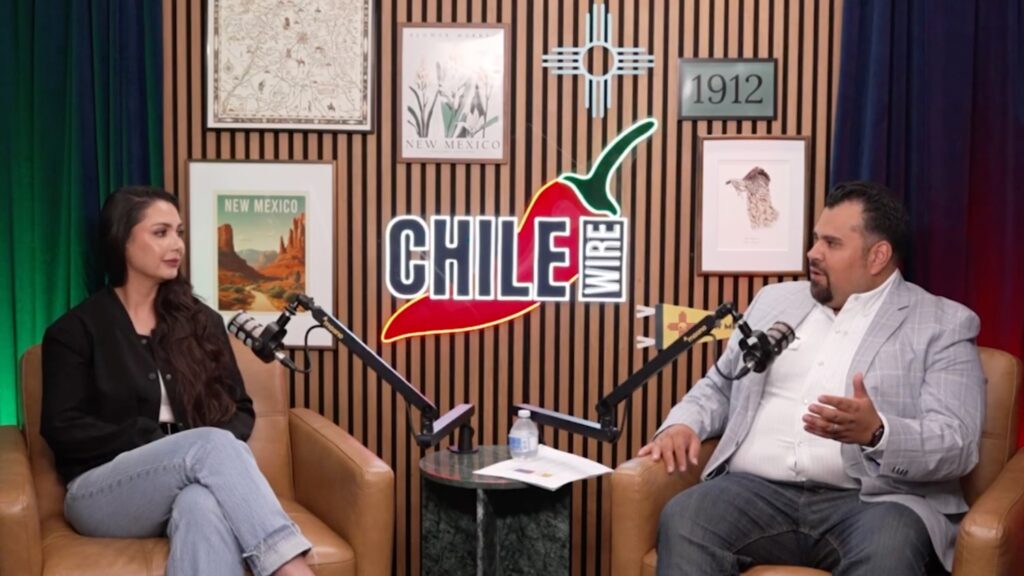
Kristy Borrego Ojinaga, a Santa Fe mother of two, says her family’s experience with the Santa Fe Public School District tells a different story — one she laid out in an exclusive interview with The Chile Wire podcast, hosted by Abe Baldonado, in an episode shared with the New Mexico Sentinel.
A First-Grade Bathroom
Ojinaga said her daughter, then six and in first grade, came home from school one day last September uncharacteristically quiet. Pressed gently over several days, the girl eventually told her parents that a male classmate — one teachers referred to as a girl — had been following her into the girls’ restroom.
“He follows me into the bathroom,” Ojinaga recalled her daughter saying. “She sends him in there with us,” referring to the teacher. Ojinaga said her daughter also described the boy touching himself in class and told them he had exposed himself to classmates the previous spring.
When Ojinaga raised the issue with the school, she said administrators disclosed for the first time that the boy had a “gender support plan” — a district-level accommodation Ojinaga said she’d never heard of. “Why didn’t I know that that there was gonna be a biological boy in the bathroom with my daughter?” she said. “Had you told me in the beginning of the year, [I] would have put boundaries around her that I felt were safe for my six-year-old daughter.”
School officials cited federal student-privacy law, FERPA, for withholding the boy’s identity — a point Ojinaga doesn’t dispute — but she says the district went further, declining to say whether any parents would be notified at all. A district wellness coordinator, whom Ojinaga did not name, told her the exposure incident was “historic” and that studies showed the other child faced more risk using a bathroom aligned with his biological sex than her daughter did sharing one with him. Ojinaga said she requested the studies; she says both cited surveys of transgender and nonbinary populations ages 13 and up, not first-graders.
What HB 7 Actually Does
HB 7 — formally the Reproductive and Gender-Affirming Health Care Freedom Act — bars “public bodies,” a category that includes school districts and the employees acting on their behalf, from imposing any policy that restricts or discriminates against a person’s access to reproductive or gender-affirming care. Violations can draw a $5,000 fine and expose violators to civil or criminal liability.
The bill passed the House 38-31 and cleared the Senate 26-16 largely along party lines. Republican attempts to amend it — including a Rep. Rod Montoya proposal requiring parental consent for minors seeking gender-affirming care or abortion, and a Rep. T. Ryan Lane amendment limiting the law to emancipated minors or adults — both failed. Lead sponsor Rep. Linda Serrato argued the amendments would have been “unfriendly” and cited research that parental-notification requirements can increase risk for LGBTQ minors.
Ojinaga said district staff separately pointed to HB 7 while explaining why parents aren’t looped in earlier. “School staff did use House Bill seven as kind of a justification of leaving parents out,” she told Baldonado, saying she later met with a legislative sponsor to understand the law’s intent firsthand. Her read: whatever the bill’s authors meant, school staff are interpreting even routine disclosure to parents as prohibited “interference” — and are acting accordingly.
What Advocates and Opponents Said
Backers of HB 7 framed it in 2023 as protecting minors, not sidelining parents. ACLU-NM attorney Ellie Rushforth called it “lifesaving legislation” at the signing. Sponsors emphasized bodily autonomy and medical privacy, not classroom bathroom policy specifically — HB 7 does not mention children or schools by name, a point critics of the GOP’s characterization of the bill have made. KOB 4’s June 2023 explainer went further, reporting that the law “does not say the word ‘parent’ even once” and quoting Southwest Women’s Law Center attorney Hailey Zock’s assurance that the bill simply bars public bodies from “discriminating” against people who seek or refuse the covered care — not from involving parents.
Republicans warned at the time that the law’s broad language would be read by districts as a license to exclude parents from more than medical decisions. After the bill passed, House Republicans circulated a form letter urging parents to demand advance notice before their children encountered lessons or services touching on “transgender ideology,” gender-affirming care, abortion or contraception.
New Mexico’s Public Education Department called the letter unenforceable, while telling reporters school-based health providers don’t perform interventions without parental notification — a claim Ojinaga’s account does not directly test, since her daughter’s classmate was not her own child and no medical intervention for him was at issue.
Gender support plans of the kind at the center of Ojinaga’s account are not creatures of HB 7 itself; Ojinaga said they exist at the district level in Santa Fe, Albuquerque, Rio Rancho, Los Alamos and Las Cruces, and vary somewhat by district. She said she could not determine what state oversight, if any, governs how or when they’re used.
Going Public
Ojinaga’s account first surfaced publicly this month in a feature published by Independent Women, a national advocacy outlet, under the headline “Santa Fe Mom Says School Chose Gender Ideology Over Her Daughter’s Privacy — But She’s Fighting Back.” That piece reports Ojinaga has since withdrawn her children from Santa Fe Public Schools and joined other parents in a federal Title IX complaint against the district, arguing its practices compromise the privacy and safety of female students.
On The Chile Wire, Ojinaga said she has since met with legislators from both parties. “The majority have listened, have talked to me, we’ve brainstormed about kind of what can we do,” she said, though she said a handful “totally dismissed” her account. She described the issue as a parental-rights question rather than a partisan one: “It’s not a right versus left issue as far as I’m concerned.”
Santa Fe Public Schools was not contacted for this story.