
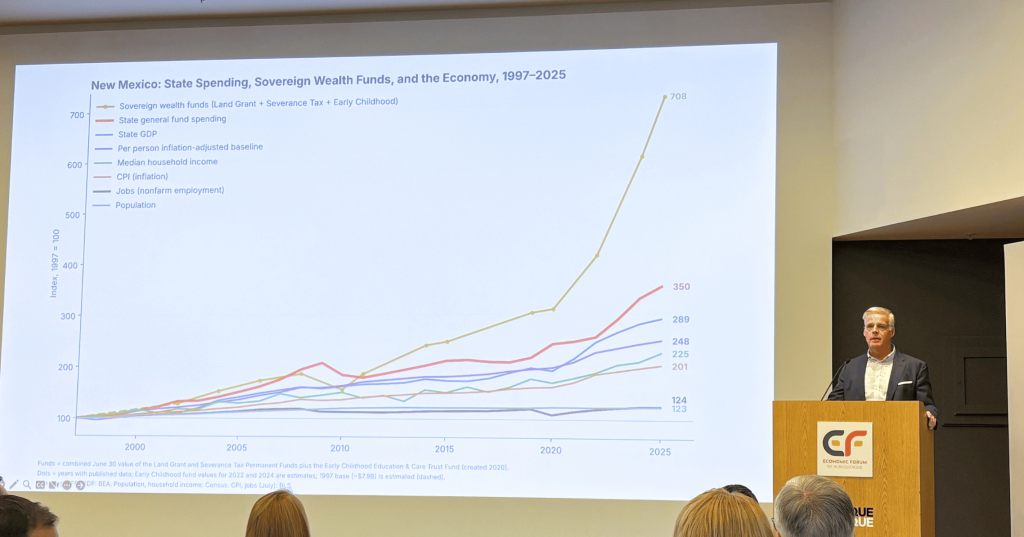
ALBUQUERQUE, N.M. — New Mexico has the financial resources to eliminate its personal income tax, provide immediate relief to working families and create an economic environment that encourages young people to stay and businesses to relocate, according to longtime business leader Steve McKee.
Speaking Oct. 21 at the Economic Forum of Albuquerque, McKee urged state leaders to take advantage of record revenues, substantial financial reserves, and growing investment income to repeal the tax without reducing existing government services.
“How about we do both — give ourselves and two million of our fellow New Mexicans a raise?” McKee asked, describing how additional take-home income could help families afford groceries, mortgages, school supplies, and other everyday expenses.
According to McKee’s calculations, eliminating the tax would save a married couple with $50,000 in taxable income more than $1,700 annually, while a single taxpayer with $35,000 in taxable income would save more than $1,000.
Beyond immediate tax relief, McKee emphasized the opportunity to reverse New Mexico’s longstanding struggles with population loss, limited job growth, and the departure of young families seeking opportunities elsewhere.
He cited data showing New Mexico lost nearly 57,000 residents to other states between 2012 and 2023, with additional losses in subsequent years. Many departing residents are working-age adults, young families, and college graduates.
He argued that eliminating the income tax would help New Mexico compete with lower-tax states for workers, employers and investment, creating more opportunities for younger generations to build careers and raise families without leaving home.
Economic modeling conducted by the D.C. based-Office of Fiscal and Regulatory Analysis (OFRA) projected that repeal could generate 310 to 620 additional business formations and approximately 4,900 to 9,900 jobs.
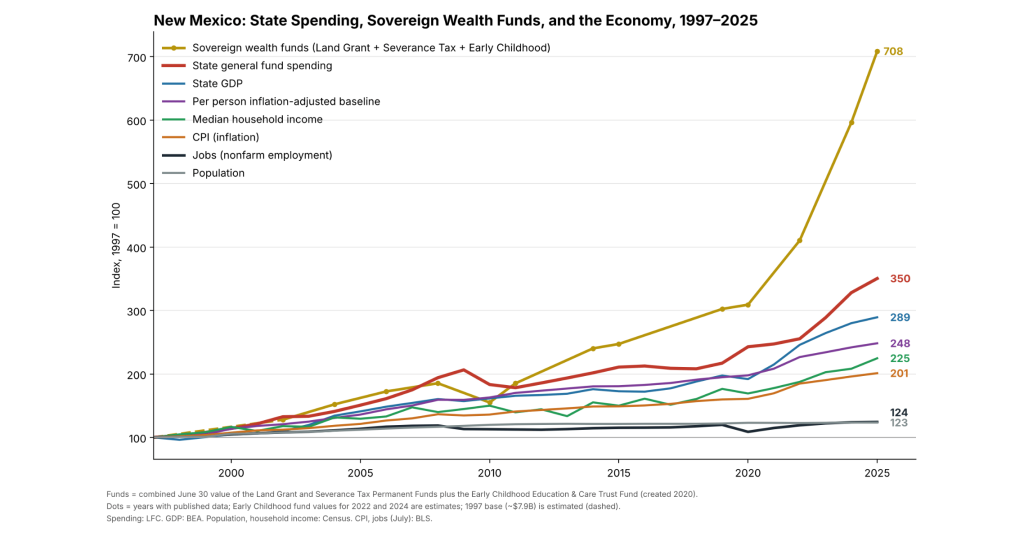
McKee said New Mexico’s financial position makes the proposal achievable without sacrificing existing public services.
The state’s August 2026 revenue forecast projects approximately $14.8 billion in general fund revenue for fiscal year 2028, while reserves were expected to total approximately $4.4 billion at the end of fiscal year 2026. McKee also cited the state’s roughly $75 billion in sovereign wealth funds, whose annual investment income he said exceeds personal income tax collections.
McKee estimated that eliminating the tax while preserving existing refundable tax credits for low-income families would require approximately $3 billion annually, an amount he argued could be covered through existing state resources without reducing current spending.
“So, can we afford to repeal the personal income tax? We can,” McKee said. “And can we do it while preserving the existing refundable tax credits for low-income families? We can, and we should. Keeping those refundable credits protects the least fortunate among us and ensures that nobody goes backwards.”
A Legislative Finance Committee analysis of a 2025 income tax repeal proposal acknowledged that eliminating the tax could increase disposable income, encourage consumer spending, improve business competitiveness, and attract residents and employers.
The analysis also cautioned that repeal could increase dependence on volatile revenue sources. McKee countered that the state’s reserves, projected surpluses and investment earnings provide significant financial capacity. He also argued that additional consumer spending and economic activity would generate gross receipts tax revenue, offsetting part of the lost income tax collections.
The permanent funds have legally designated uses, and maintaining services without future reductions would depend on how lawmakers structure and finance repeal.
“We can repeal the income tax using existing revenues that already exceed the state budget,” McKee said. “We can do it without any spending cuts — no cuts to public schools, no cuts to health care, no cuts to law enforcement, no cuts to any other services.”
McKee urged New Mexico leaders to consider the long-term economic benefits of allowing residents to retain more of their earnings while making the state more attractive to future generations.
“Let’s repeal the income tax and turn around our birth dearth and brain drain and economic doldrums,” he concluded.