
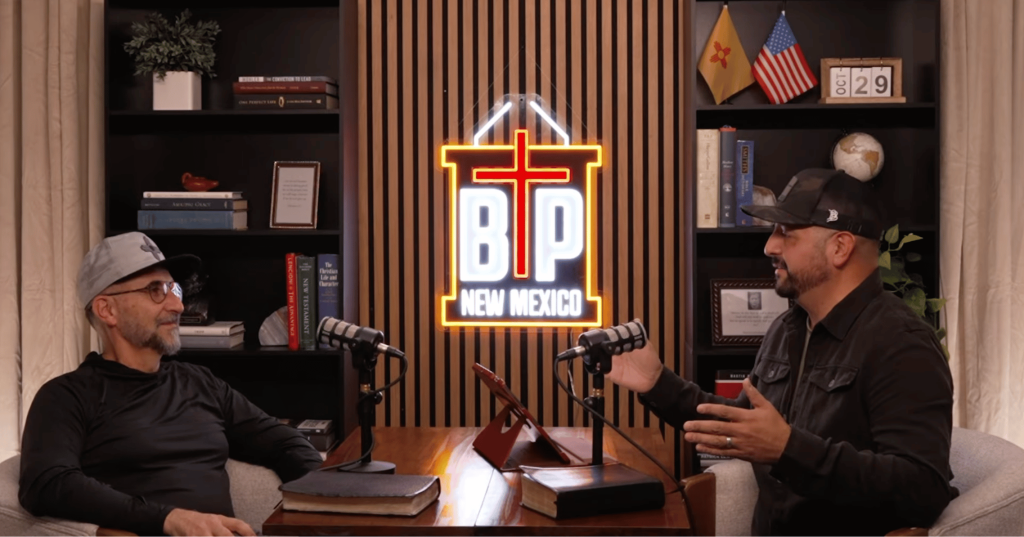
SANTA FE, N.M. — Vince Torres has launched a new podcast aimed at bringing pastors and faith leaders into conversations about politics, culture and the role of the church in civic life, beginning with an episode featuring Santa Fe pastor Carlos Montoya.
“The Bully Pulpit” is intended to explore issues at the intersection of faith and politics, with Torres saying the goal is not to make churches more political but to encourage Christian leaders to examine public issues through a biblical framework.
“Most of my life, I have spent living at the intersection of both faith and politics,” Torres said in the opening episode. He said one of his concerns has been what he sees as pressure on Christians to disengage from civic and political life.
Torres said future episodes will feature candid conversations with pastors and faith leaders about issues affecting churches, families, and communities.
For the inaugural episode, Torres sat down with Montoya, pastor of Blaze Christian Fellowship in Santa Fe, for a discussion modeled after conversations the two have regularly had about Scripture, theology, politics and culture.
Montoya, a Santa Fe native, said he became a Christian in the early 1990s and later entered ministry after being asked to teach a youth group. He eventually planted Blaze Christian Fellowship, where he has served for more than two decades.
Much of the episode focused on the role pastors should play when cultural and political debates overlap with religious teaching.
Montoya argued that pastors have a responsibility to address those subjects when they arise through Scripture, rather than avoiding them because they have become politically controversial. He said pastors should equip church members to apply their faith beyond Sunday worship, including in their families, workplaces, communities and civic participation.
“If we’re only picking and choosing our favorite text,” Montoya said, churches risk failing to prepare members for competing cultural messages.
The discussion also addressed why some pastors may be reluctant to speak about controversial issues. Montoya pointed to concerns about losing members, creating conflict within congregations or facing pressure from denominational structures.
Torres said the podcast is designed in part to encourage pastors to engage those questions more directly, particularly in New Mexico, where religious beliefs, political identity and cultural traditions often intersect.
The two also discussed voting and civic engagement, with Montoya arguing that Christians should view participation in government as part of their responsibility to their communities. He said voters should evaluate candidates based on policies and their likely effects rather than expecting political candidates to meet the standards of a pastor or spiritual leader.
The episode touched on abortion, sexuality, family life, government, discipleship and the responsibility of churches to address cultural change. Montoya also emphasized that Christians should be willing to acknowledge when they do not know enough about a political or policy question and then seek additional information.
Torres closed the episode by reiterating that the podcast is not intended to present politics as the ultimate solution to cultural problems.
“This isn’t a call for the church to be more political,” Torres said. “This is a call for the church to be biblical in how we engage the culture and engage politics.”
Montoya concluded the inaugural episode with a presentation of the Christian gospel and a prayer for listeners.