
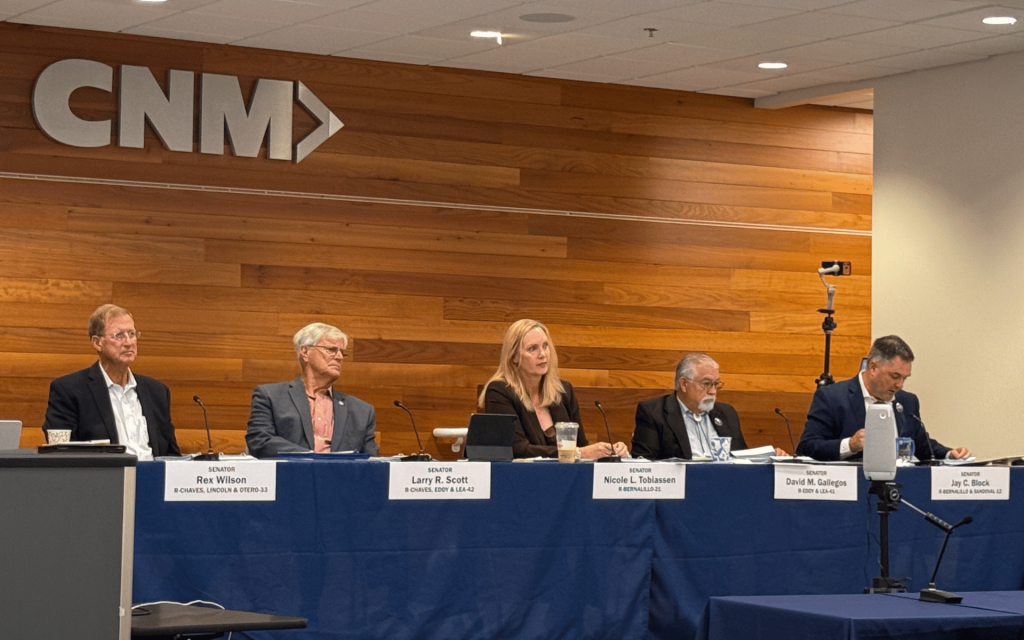
ALBUQUERQUE, N.M. — Earlier this week, the New Mexico Senate Republicans convened a taskforce hearing to address serious, longstanding concerns with the Children, Youth and Families Department. CYFD has faced criticism over its protection of children in state care, with public concern escalating after the New Mexico Department of Justice disclosed in April that 14 children died in agency care over the last two years. Former agency leadership, child advocates, and frontline personnel delivered testimony highlighting systemic breakdowns within CYFD during the hearing.
The task force was led by state Sen. Nicole Tobiassen, R-Albuquerque, the committee chair; and Sens. David Gallegos, R-Eunice; Jay Block, R-Rio Rancho; Larry Scott, R-Hobbs; and Rex Wilson, R-Ancho. Republican leaders organized the panel to evaluate operational failures, budget transparency, and structural reforms needed to protect vulnerable children. The hearing brought to light chronic understaffing, high caseworker turnover, and ongoing policy debates over child safety versus family reunification in state care.
What Prompted the Hearing
During opening remarks, lawmakers detailed severe department failures, citing the suicide of a 16-year-old youth in a congregate care facility, the starvation death of a nonverbal teenager despite seven separate agency referrals, and the missing status of a 15-year-old boy left at the El Paso border. The boy, an American citizen under CYFD care in New Mexico, was ordered by the agency earlier this year to live with his mother in Mexico. The agency had previously determined the mother to be abusive, but staff dropped the youth off at the U.S.-Mexico border to find his way back to her despite his unwillingness to go. The boy remains in Mexico, and his exact location and well-being are unknown.
“Good people cannot outrun a broken system,” Tobiassen stated, emphasizing that while state appropriations for child welfare have increased, funding must translate directly into safer outcomes, lower caseloads, and faster response times.
Dawn Walters, head of the Office of the Child Advocate, detailed progress in establishing her independent oversight office, which has fielded over 170 complaints and inquiries. The Office of the Child Advocate was established in 2025 to provide independent oversight for CYFD. Walters urged state leaders to grant her office real-time, electronic access to CYFD database records to conduct timely investigations. She also pointed to systemic communication breakdowns, prolonged temporary safety plans, and sudden placement shifts as major sources of ongoing trauma for youth.
Testimony From CYFD Youth
The panel heard personal testimony from Jackie, a 17-year-old high school graduate who spent 13 years in CYFD custody. Jackie testified to living in over 100 placements, attending 50 different schools during her freshman year alone, and repeatedly sleeping in agency office buildings starting at age 13 due to placement shortages. She noted that agency caseworkers currently refuse to help her obtain her birth certificate and Social Security card or assist with driver’s education.
“Most of them see us as bad kids, but we’ve just been through so much and we just keep on pushing forward,” Jackie told lawmakers, expressing a desire to eventually work for CYFD to support other foster youth.
Testimony From CYFD Employees
Former CYFD Cabinet Secretary Monique Jacobson emphasized that the department’s overarching focus must remain strictly on the best interests and safety of the child, rather than the reunification of the family unit or political considerations. Jacobson noted that widespread substance abuse remains a primary driver in child welfare cases, complicating agency decisions when active addiction is not legally classified as creating imminent harm.
Former caseworker Evan Sena described a chaotic workplace where new hires received minimal preparation before taking on heavy caseloads. Sena testified that workers were frequently pulled away from case management to perform statewide transportation duties and faced safety risks without support, leading to rapid turnover. Sena cited internal figures indicating average caseworker retention lasts just three months.
Attorneys and social work experts called for systemic shifts, including opening child welfare court proceedings to public oversight, decoupling child representation from family defense agencies, and rebuilding supervisory mentorship. Dr. Gwen Perea Warniment of the LANL Foundation presented data showing nearly 69,000 New Mexico children are raised by relatives outside the formal foster system, advocating for expanded financial and legal support for grandfamilies.
Democratic Response
New Mexico House Democrats held a news conference Tuesday addressing CYFD concerns. Witness and caseworker testimony was absent, with the gathering consisting solely of Democratic state legislators outlining proposed reforms. House Speaker Javier Martínez, D-Albuquerque, acknowledged CYFD’s “toxic” culture and the need for a “shift in culture.” Democratic lawmakers stated their desire to increase the power of the Office of the Child Advocate to oversee CYFD activities. Other representatives suggested solutions such as preventing children under 12 from living in group homes and creating an independent committee to provide oversight for CYFD.
Senate Republicans characterized the news conference as an attempt to preempt the Republican task force. Tobiassen criticized executive leadership, stating, “Under this governor, this agency has really eroded, and we’ve seen some of the most egregious cases possible, so we have to have change.”
Referring to Senate Republicans, Tobiassen said, “Last summer, we started having our own taskforce committees and putting our own things together in different categories where we felt that the majority party was not hearing us and not scheduling meaningful committee meetings… it has to be resolved and we have an opportunity with a new administration to set a different tone and put this agency on a different course and help more kids around the state.”
Looking Ahead
Tobiassen argued that CYFD’s failures reflect broader policy missteps. “The agency has it wrong. They are focused on reunification, they aren’t focused on the whole child — mind, body, spirit,” she said. “That’s fundamental to being human. If we aren’t doing that, we’re failing them every single day that they’re in state custody… There’s problems in the family, there’s crises with these families, there’s a lack of the ability to parent properly in the family unit which is why the child is in state custody to begin with. So, first and foremost, it’s about the safety of the child. The family comes second. Instead, we’re placing kids of all ages back with their known abusers and adults who are addicted to substances.”
Senate Republicans vowed to continue pushing for child welfare reform, highlighting the role upcoming state leadership decisions will play in shaping the department’s trajectory.