
This time, The Santa Fe New Mexican editorial board directly targeted friends of mine and local parents who had the courage to stand up, ask questions, and speak out about what’s happening in their children’s schools.
But let’s review how we got here.
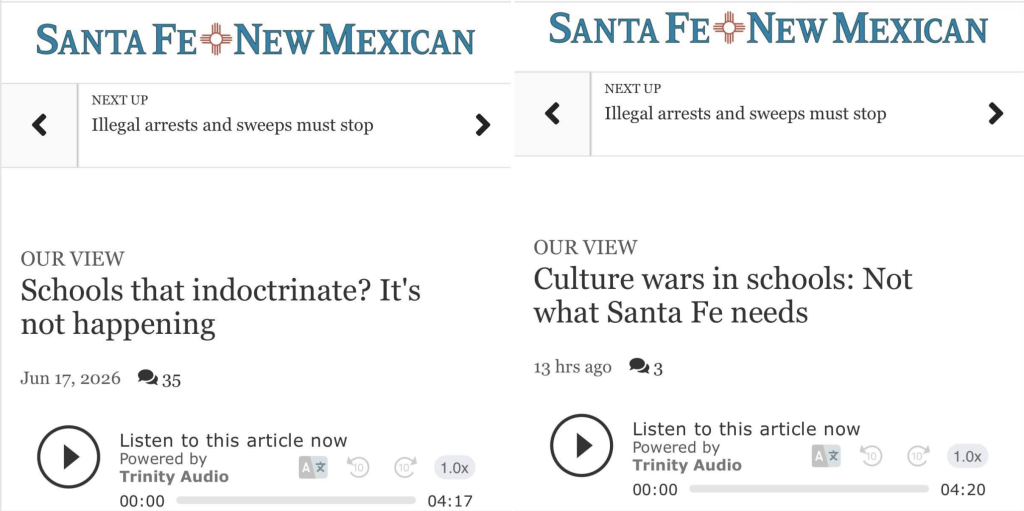
In June, the editorial board of the New Mexican published an opinion piece titled, ‘Schools that indoctrinate? It’s not happening.’ The editorial targeted Independent Women, a national organization working with local parents to raise awareness about public school policies on gender identity and sexuality. Without providing evidence, the editorial board simply declared, ‘Let’s be clear. New Mexico children are not being indoctrinated into changing their gender identity.’
Now, as more local parents have come forward with concerns and real life stories, the New Mexican this weekend returned to the issue. This time, rather than insisting nothing is happening, the editorial board dismissed the debate as a ‘culture war’ Santa Fe doesn’t need.
But parents asking questions about what happens to their children at school isn’t a culture war. It’s good parenting.
Last week, the Santa Fe Public School Board heard from several local families affected by the district’s curriculum and gender support plans. Then came news of a lawsuit filed against Albuquerque Public Schools by a school counselor who claims the district’s policy on gender identity requires her to conceal information from parents. According to the lawsuit, APS directive PJ30 directs APS staff to use a child’s preferred gender identity at school and hide that information from parents unless the child gives permission. Whatever we think about the broader debate over gender identity, this should trouble all parents.
The New Mexican previously dismissed concerns like these as ‘clickbait,’ but similar disputes have already reached the federal courts. In Mirabelli v. Bonta, a federal court blocked enforcement of California policies that conceal a child’s gender identity from parents. But while the courts sort through the constitutional questions, parents and children are dealing with the issue right now.
SFPS recently revised its policy to require parental involvement in formal gender support plans involving changes to the district’s student information system. That was a positive step, but the policy still directs staff to use a student’s requested name and pronouns in everyday interactions regardless of whether parents are involved.
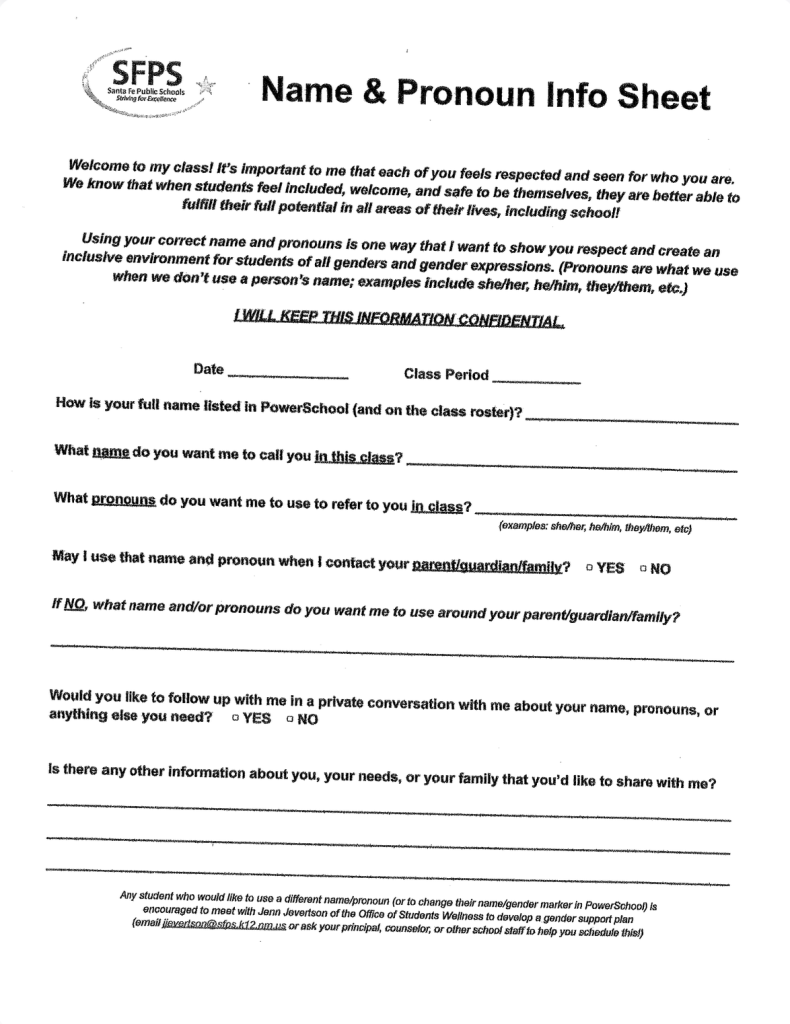
Recently, a parent shared a classroom worksheet his child brought home asking students for their preferred names and pronouns, and whether those names and pronouns should be used with their parents.
Read that again.
A child is being asked at school to share personal information about himself or herself that school employees may use differently when speaking with mom and dad.
The New Mexican flatly insists teachers aren’t doing this, but evidence like this proves otherwise. At some point, ignoring evidence that contradicts your narrative stops looking like journalism and starts looking like activism, which, given who sits on the New Mexican’s editorial board, may not be all that surprising.
Call it indoctrination or don’t. Call the debate a ‘culture war’ if you want. But let’s be honest. Those labels seem to just be a ploy to avoid the much more important question of why schools would make a practice of inserting themselves between children and parents.
As parents, we send our children to school each morning trusting teachers and administrators with what’s most precious to us. We expect schools to educate our children, keep them safe and work alongside us. We don’t expect or want them to create a separate space in which significant parts of our children’s lives are intentionally hidden from us.
Parents are not outsiders in our children’s education, and we are not an obstacle schools have to navigate around.
The New Mexican previously ended its editorial with, ‘We will speak out and protect all our children.’
On that point, we agree. But protecting children begins by remembering who bears the first and most fundamental responsibility for them.
It’s not an editorial board. It’s not a school district. It’s not even a teacher. It’s parents.
And when policies or practices push parents out, we have every right and every responsibility to push back.
It’s hard to see pieces like this as anything other than an attempt to intimidate and shame parents who have had the courage to speak up, hoping they’ll retreat into silence. But knowing these parents, silence is no longer an option.
These conversations will continue until meaningful changes are made and the fundamental right of parents to direct the care and upbringing of their children is once again respected.