
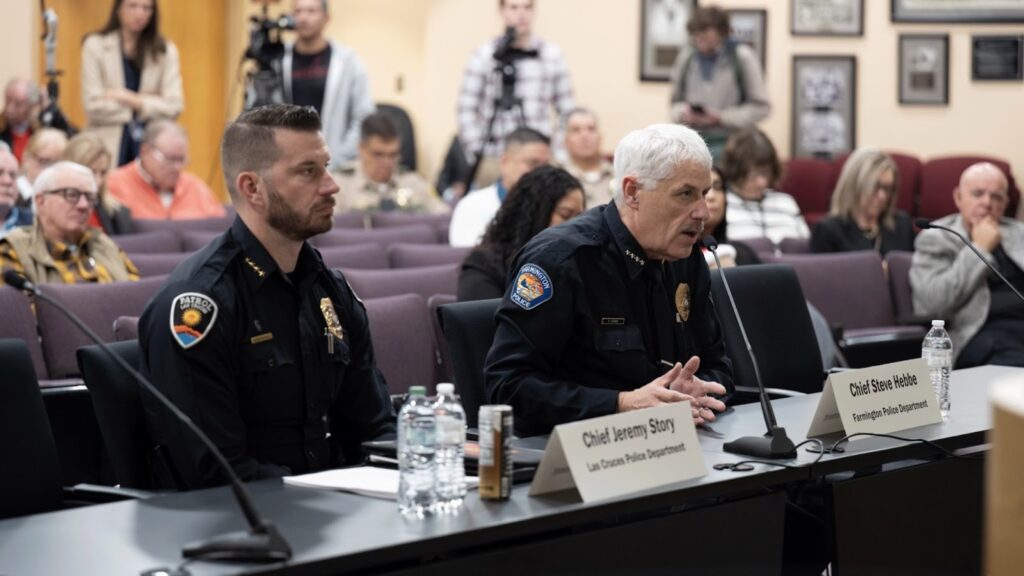
LAS CRUCES, New Mexico — Las Cruces Police Chief Jeremy Story told lawmakers Monday that every juvenile defendant his department has seen declared incompetent under New Mexico’s state system was later found competent when prosecuted federally, raising concerns about how the state handles juvenile competency cases.
Story made the comments during Monday’s meeting of a legislative juvenile justice task force in Las Cruces, where lawmakers, law enforcement leaders and prosecutors examined rising juvenile violence and gaps in the state’s Children’s Code.
“I can give you the facts,” Story said during the hearing. “Every juvenile that we’ve had that has been found incompetent under the state competency system has been found competent in the federal system.”
Story said the legal standard for competency is similar at both levels — whether a defendant understands the charges and can assist in their defense — but the outcomes differ sharply because of how evaluations are conducted and enforced.
“The process is different. The evaluators are different,” Story said, adding that in federal cases juveniles are consistently found competent, often before any restoration process is required.
He told lawmakers that state competency findings frequently lead to cases being dismissed and juveniles released, even in serious violent offenses, forcing law enforcement to rely on federal prosecution as a last resort.
“What we’re doing is essentially nothing, and then they get into these cases where the feds pick it up,” Story said. “By the time that happens, somebody’s killed in most cases, and they are gone for a decade or more.”
Story also testified that juveniles are openly exploiting the state system. He described recorded jail calls in which youths discussed intentionally failing competency evaluations to secure dismissal of their cases.
“One kid said, ‘I’m just going to do this test,’” Story told lawmakers. “He knows that once he’s found incompetent, his case gets dismissed. He’s beaten every case that way.”
According to Story, juveniles involved in violent crimes often demonstrate awareness of wrongdoing by fleeing, concealing evidence and coordinating with others — behavior he said contradicts claims that they lack competency.
“They deny the act. They tamper with evidence. They get rid of guns,” Story said. “That demonstrates they know exactly what they did was wrong.”
Lawmakers noted that reforms to New Mexico’s criminal competency statutes passed last year apply only to adults, leaving juvenile cases governed by older provisions of the Children’s Code. Several said Story’s testimony underscored the need to revisit juvenile competency laws in the upcoming legislative session.
“There is clearly something not working in our state,” one legislator said during the hearing.
Story said without changes, New Mexico will continue cycling repeat violent offenders through the juvenile system with little accountability, while victims and communities absorb the consequences.
“We don’t have accountability or rehabilitation right now,” he said. “That’s the problem. We have neither.”