
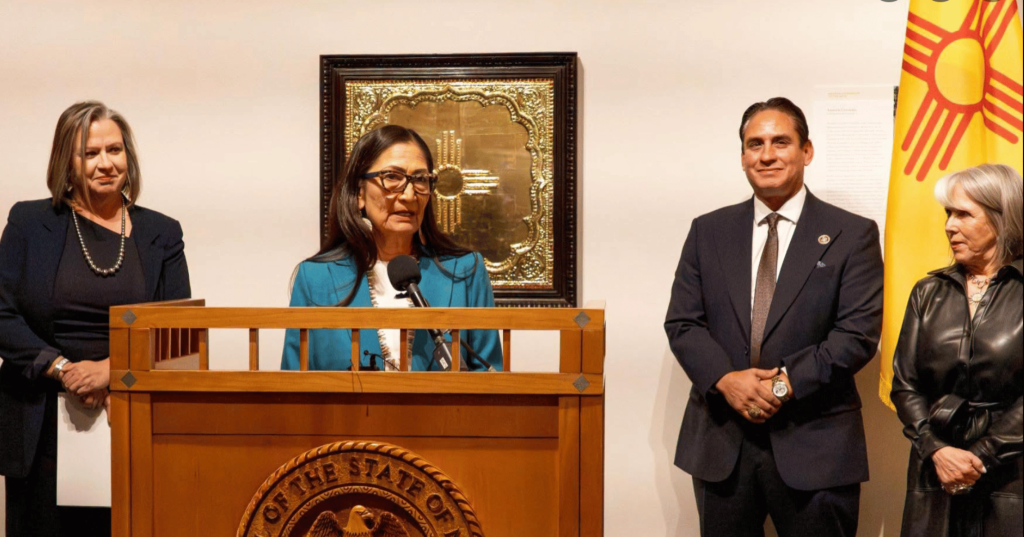
SANTA FE — Gov.-elect Deb Haaland has not said whether she will keep New Mexico in the federal school choice tax credit program that Gov. Michelle Lujan Grisham joined this month, as Democratic lawmakers and teachers unions press the incoming administration to pull out.
Haaland spokesperson Hannah Menchhoff told the Santa Fe New Mexican on Nov. 17 that the governor-elect “is reviewing the policy.”
The choice will reach Haaland within weeks of taking office Jan. 1. For the program’s first year, states must file an IRS election by Jan. 1 and submit a list of approved scholarship-granting organizations by Feb. 15, 2027, Ballotpedia News reported. Lujan Grisham has already filed the election, according to Ballotpedia. Starting in 2028, both are due Jan. 1, and states must opt in each year.
As the Sentinel reported Nov. 12, Lujan Grisham’s office announced Nov. 4 that New Mexico would become the 32nd state in the program. Created by the One Big Beautiful Bill Act, it gives taxpayers a federal credit of up to $1,700 a year for donations to nonprofit groups that fund K-12 scholarships, starting Jan. 1. The governor’s office said the Public Education Department would set up a process to certify those groups “in the coming weeks.” The state has none yet, the New Mexican reported.
Public Education Department spokesperson Janelle Taylor García told the New Mexican the state must first launch an application process and it was not yet clear when that would happen, but that the state would meet the Feb. 15 deadline.
Opponents stepped up their criticism this week. At a news conference Tuesday, Sen. Linda Lopez, D-Albuquerque, said she was “very disappointed” in the governor’s decision and called the program “a backdoor entry to remove money from our public schools,” according to Source NM reporting carried by KSFR.
Bethany Jarrell, president of the National Education Association New Mexico, called the credit “a voucher scheme.” Rep. Andrés Romero, D-Albuquerque, who chairs the House Education Committee, said the decision undermines the Legislature’s work for students covered by the Yazzie/Martinez ruling. He called claims that the money will fund after-school programs “a hope and a wish.”
Kris Nordstrom, research director at New Mexico Voices for Children, told the New Mexican the 2027 decision may not be reversible but urged Haaland to act on the next one: “now is the time to loudly and clearly state your intentions to withdraw New Mexico from this program in 2028.”
Lujan Grisham’s office has defended the move. Communications director Michael Coleman said she “would have preferred more direct federal investment in public education in lieu of this tax credit — full stop,” but that opting out would send New Mexico donors’ money to other states. “Given those limited choices, Governor Lujan Grisham decided to keep that money in New Mexico where it belongs,” Coleman told the New Mexican.
Virginia shows how a reversal could play out. Gov. Abigail Spanberger, a Democrat, confirmed Nov. 16 that her state would not take part, undoing her Republican predecessor’s opt-in, K-12 Dive reported. Treasury Secretary Scott Bessent responded on X that Virginia “has already elected to participate in 2027” and that the governor “is required under federal law to complete the administrative process,” according to Ballotpedia. It is unclear whether a governor can block participation by not submitting the scholarship list, Ballotpedia reported.
Haaland did not address school choice during her campaign, according to a Nov. 11 review by EdChoice, a school choice advocacy group, which rated her position unclear. Since the election she has named improving public education as a top priority, KOAT reported, without addressing the credit. AFT New Mexico plans to discuss the program’s future with her, according to KOAT.
Republicans want the program kept. Sen. Gabriel Ramos, R-Silver City, ranking member of the Senate Education Committee, called the opt-in “common sense” in a Nov. 6 statement from Senate Republicans. “This decision may come up for reconsideration in January,” Ramos said, adding that he and his colleagues “fully support keeping New Mexico in this program.”