
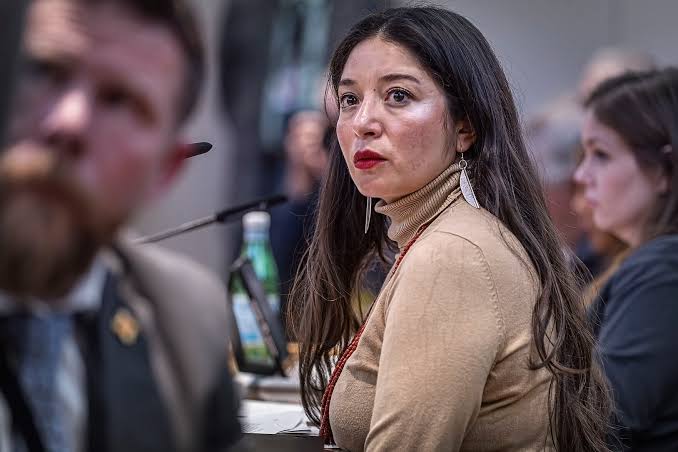
SANTA FE — State Rep. Andrea Romero, D-Santa Fe, is making headlines this week, appearing in the nation’s capital alongside U.S. Rep. Melanie Stansbury to promote a newly commissioned investigation into the infamous Zorro Ranch. But for some longtime observers of the New Mexico Roundhouse, the renewed focus on “victim advocacy” raises questions about her past legislative record.
The bipartisan “Epstein Truth Commission,” chaired by Romero, was launched with a $2.5 million budget and a mandate to investigate why convicted sex offender Jeffrey Epstein was never required to register as a sex offender in New Mexico. A review of legislative records, however, shows that when Romero had an opportunity to address registration loopholes in 2020, she voted to table the proposal.
The 2020 Vote
In 2020, House Bill 43 was introduced by then-Rep. Matthew McQueen, with the stated goal of ensuring out-of-state sex offenders could not avoid registration requirements while residing in New Mexico. Supporters argued the bill would close gaps in the state’s registry system. The measure did not advance to the governor’s desk.
Legislative records show Romero, along with Rep. Angelica Rubio, D-Doña Ana, voted to table the legislation during the session, effectively halting its progress.
Commission in Washington
Six years later, Romero is promoting the Truth Commission as a step toward accountability. In Washington, D.C., she and Stansbury described the effort as a historic move to examine potential failures related to Epstein’s activities in New Mexico.
Critics, however, suggest the commission is less about “truth” and more about political cover. By spending millions in taxpayer funds to “investigate” a dead man’s ranch, Romero is conveniently shifting the spotlight away from her own voting record that allowed those same loopholes to persist for years.
“It is the height of hypocrisy to see Representative Romero taking a victory lap in DC for an investigation into a problem she helped maintain,” said one local advocate for judicial reform, who requested anonymity to speak freely. “In 2020, she had a chance to protect our children with HB43. She chose to table it. Now, she wants us to believe she’s the one leading the charge for accountability.”
Questions Over Cost and Timing
The Zorro Ranch investigation is expected to run through the end of 2026 and will have subpoena power to examine potential public corruption and law enforcement failures. While supporters say uncovering the full scope of Epstein’s operations in New Mexico is necessary, critics question the timing and cost of the effort.
As the commission begins its work, debate continues over whether the $2.5 million appropriation represents overdue accountability or a politically timed investigation.