
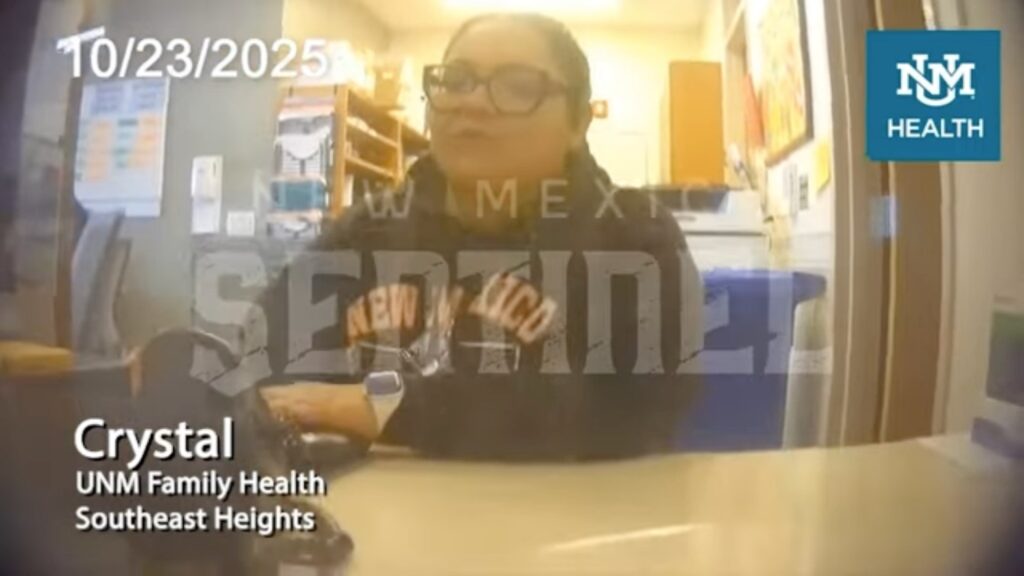
ALBUQUERQUE — Staff at a University of New Mexico-affiliated clinic described a process for out-of-state patients, including those traveling from Texas, to obtain gender-affirming care during short visits to Albuquerque, according to an undercover video obtained by the New Mexico Sentinel.
The footage is part of an ongoing Sentinel investigative series examining how minors and out-of-state patients access sensitive medical services in New Mexico.
In the recording, a staff member at UNM Family Health’s Southeast clinic outlines how patients traveling from Texas can schedule appointments, complete lab work and receive prescriptions within a single visit.
“Basically, the way it works is I just make a new patient visit,” the staff member said. “You come into a new patient visit and bring all the questions you have. At that time, they’ll order lab work for you, and then if you want to start medication, they’ll send the medication to a pharmacy that’s close to the airport.”
The conversation suggests that patients may travel to Albuquerque for same-day or short-term visits, with prescriptions filled locally before returning home.
“A lot of our patients that come from Texas use Southwest because it leaves really early in the morning,” the staff member said. “You come and then you leave in the afternoon.”
The staff member added that some patients choose to stay overnight, but indicated the process is structured to accommodate brief visits.
According to the recording, the clinic currently limits this process to patients traveling from Texas.
“We only service patients from Texas,” the staff member said, adding that expansion to other states has not been implemented due to legal and regulatory considerations.
The conversation also addressed cost, with staff describing the care as self-pay.
“It’s 100% self-pay,” the staff member said, estimating that patients typically pay between $500 and $800 for an initial visit and lab work, depending on what is ordered.
The undercover journalist also asked about surgical procedures, including gender-affirming surgeries such as “bottom surgery.” The staff member said additional information would be provided through a social worker associated with the clinic’s primary provider for these patients.
“When you come to the appointment, there’s a social worker that works with Dr. Hutcheson, and she has more information about all that stuff,” the staff member said, adding that those services are also paid out of pocket.
The staff member identified Dr. Hutcheson as the provider who primarily works with patients traveling from Texas and said follow-up communication would be coordinated through a social worker.
The recording does not specify what evaluation protocols, eligibility requirements, or consent processes apply before medications or referrals are provided.
New Mexico has been identified as a destination for patients seeking gender-affirming care, particularly from states with more restrictive laws. However, clinical standards for such care typically involve multiple steps, including medical evaluation and, in some cases, mental health assessment.
This report builds on earlier Sentinel investigations into abortion access and gender-related care pathways involving minors and out-of-state patients.