
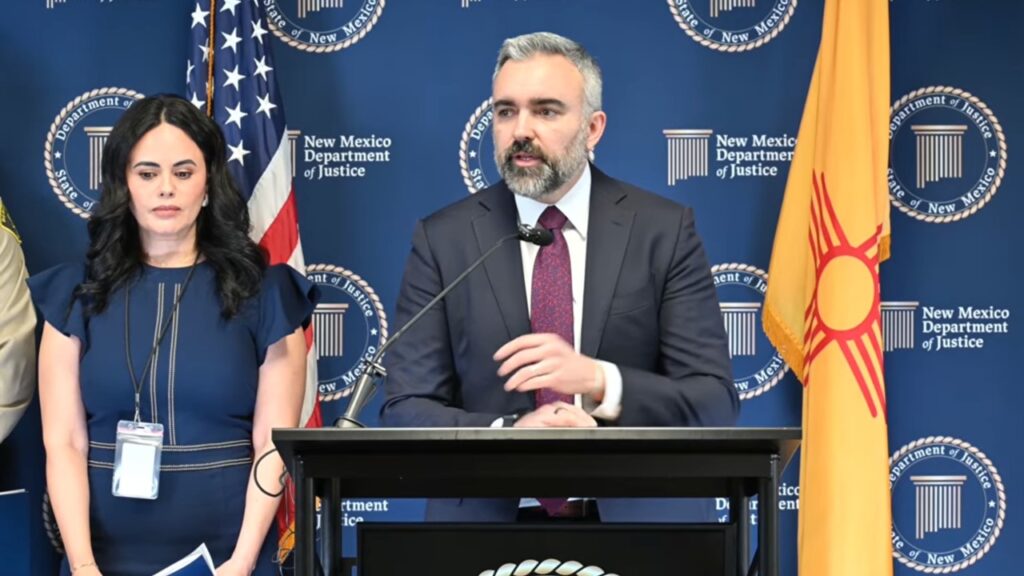
SANTA FE — New Mexico Attorney General Raúl Torrez on Wednesday released a 224-page investigative report concluding that the state’s Children, Youth and Families Department has inverted its legal mandate — prioritizing family reunification at virtually any cost over child safety — and that the consequences have included at least seven preventable deaths since the probe began in April 2025.
The report, titled “Systemic Failures: How CYFD Endangers the Children It’s Meant to Protect,” was released simultaneously with a lawsuit targeting the Children’s Code confidentiality statute that the attorney general says CYFD exploited to obstruct the very investigation now exposing it. The findings represent the most sweeping government indictment of the agency in its history and span eight documented systemic failures — from unqualified executive leadership and collapsing caseloads to children warehoused in office buildings and congregate care facilities where they were physically restrained, sexually assaulted, and, in at least one case, took their own lives.
“The child welfare crisis is not an unavoidable reality, but the direct result of poor leadership, indefensible choices, missed interventions, and a widespread lack of transparency,” the report states, calling CYFD’s shortcomings “a systematic moral failing — measured in children continuing to be abused, neglected, and lost.”
The Core Finding: A Mandate Inverted
State law requires CYFD to treat child safety as the paramount concern, pursuing family reunification only when it does not conflict with a child’s health and welfare. The report’s central finding is that CYFD has done precisely the opposite — returning children to dangerous caregivers with substantiated histories of abuse or chronic neglect, including in cases where parents refused treatment and remained under active investigation for harming a sibling.
“CYFD has completely inverted that legislative mandate,” the report states, concluding the agency “prioritized family reunification at virtually any cost.”
The report documents this pattern through several detailed case studies using pseudonyms to protect the identities of children involved. In one, a young child the report calls “Leo M.” was rushed to an Albuquerque hospital and died just shy of his fifth birthday from catastrophic injuries including rib and skull fractures, brain hemorrhages, and lacerations to internal organs. CYFD, the report found, had ignored twelve credible reports of abuse and neglect over several years, closed investigations prematurely, and relied on ineffective safety plans rather than removing him from a home where danger was overwhelmingly apparent.
A former CYFD abuse and neglect investigator described the case under oath: “This haunts me. CYFD dropped the ball and a child died, and it’s not okay.”
In another case, a nonverbal, blind and developmentally disabled 16-year-old girl identified in the report as “Elena S.” died of malnutrition and dehydration in May 2022 after her mother neglected her for years. CYFD had conducted seven separate investigations into the family between 2015 and 2020, repeatedly unsubstantiated credible reports, closed cases months past mandatory deadlines without adequate supervisory review, and provided the family no meaningful services. After Elena’s death, CYFD continued to pursue reunification of the surviving children with their mother — the same mother then facing criminal charges for their sister’s death. A CYFD caseworker even testified in court in support of releasing the mother from jail so reunification could proceed.
“The gravity of this testimony cannot be overstated,” the report says. “A representative of CYFD, the entity legally responsible for the care and protection of children, testified in favor of releasing [the mother] from jail — despite [her] being accused of killing her special needs daughter through gross neglect — so the Department could reunite [her] with her surviving children.”
Eight Documented Systemic Failures
The report organizes its findings around eight specific categories of systemic failure, each supported by case studies, data, interview testimony, and expert analysis drawn from over 20,000 pages of records, interviews with former employees, foster parents, law enforcement officers, medical professionals, legislators, judges, and children who aged out of foster care.
Leadership. The report concludes that former CYFD Secretary Teresa Casados lacked the qualifications and commitment necessary to lead a child protection agency, having come from state and county government administration without expertise in social work or child welfare. Multiple former senior officials described her tenure as leaving CYFD “directionless.” The report documents that Casados allegedly hired or promoted personal acquaintances to key positions — including her son-in-law, her granddaughter, her granddaughter’s boyfriend, and a friend who had recently left law enforcement following disciplinary action. When one deputy director raised concerns about hiring unlicensed social workers and the legal and safety risks that entailed, Casados reportedly responded: “Do not ever bring that up with me again.”
After Casados resigned in September 2025, a longtime CYFD employee was elevated to acting secretary — a move the report describes as signaling “a continuation of the same leadership approach that has long failed to deliver better outcomes for children.”
Workforce. Between June 2024 and February 2025, only 7% of CYFD’s protective services workforce held social work licenses. A cross-check of CYFD’s December 2025 employee roster against the state’s Regulation and Licensing Department database found just 16 of 379 front-line and senior protective services employees — roughly 4% — maintained social work credentials. Staff turnover has equaled or exceeded 25% for over a decade and has remained above 30% for three consecutive years. The Department has seen a net gain of only 20 protective services workers between June 2024 and June 2025 despite active hiring. In 2024, nearly half of all investigators or permanency workers who voluntarily left had been employed for less than one year.
The report documents a self-reinforcing crisis: unable to retain staff, CYFD lowers hiring standards; undertrained staff make harmful decisions; those decisions produce poor outcomes and public child deaths; those deaths erode morale and recruitment; and the cycle repeats.
Investigations. CYFD investigators routinely skipped mandatory interviews, failed to conduct required home visits, misapplied risk and safety assessment tools, and over-relied on parents’ own accounts without independent verification. Investigators in some cases fabricated documentation to indicate compliance with visit requirements. Safety plans — written agreements outlining what families must do to control identified danger — were found to be incomplete, poorly monitored, and seldom enforced when violated. Cases were frequently closed months past their mandatory 45-day deadlines. Required pre-initiation supervisory meetings were routinely skipped.
Drug-exposed infants. New Mexico enacted the Comprehensive Addiction and Recovery Act in 2019, requiring CYFD and healthcare providers to develop plans of care for newborns who have been substance-exposed. The report finds CYFD has failed to implement it. Over 1,200 drug-affected newborns are at risk each year, and the rate at which CYFD screens out abuse and neglect referrals involving substance-exposed infants is now more than double the national average. Investigators repeatedly failed to use available tools — including public health nurse consultations and medical record reviews — to fully assess risk in these cases.
Law enforcement. CYFD repeatedly refused to honor law enforcement requests for emergency protective holds on endangered children, even as danger escalated — leading to continued police involvement and, in some cases, criminal harm to children who could have been removed. CYFD also delayed or prevented forensic interviews of child abuse victims, impeding criminal investigations and prosecutions. In one documented case involving two young brothers whose household had generated nearly 200 law enforcement dispatches and more than 60 CYFD involvements over 10 years, the Bernalillo County Sheriff’s Office ultimately stepped in to connect the family to services that CYFD had repeatedly failed to provide.
Foster parents. The report interviewed 25 foster parents who described a culture of retaliation, poor communication, and neglect by the agency. The Department fell short of its court-mandated foster home recruitment targets, licensing 129 homes in 2023 against a target of 190, and 212 homes in 2024 against a target of 265. As of March 2025, CYFD had 1,059 active resource homes — a net loss from six months prior — to serve 2,164 children in state custody. Over 120 recruitment events in 2024 yielded just 19 new inquiries from prospective families. A majority of foster parents who said they did not plan to renew their licenses cited frustration with CYFD as the reason.
Office stays. Children in state custody were placed in CYFD commercial office buildings — a practice that exposed them to physical injury, sexual assault, drug use, and severe psychological harm. The Kevin S. settlement agreement, a court-monitored child welfare reform compact, required CYFD to end the practice by December 1, 2020. CYFD did not. The practice continued until January 2026, when the governor issued an executive order banning it — over five years past the settlement deadline. The report warns that moving children from offices into congregate care facilities, as CYFD is now doing, “carries its own risks.”
Congregate care. The report’s final systemic failure documents what it calls CYFD’s warehousing of children in congregate care facilities — group homes and residential treatment centers — where they have been subjected to violence, staff mistreatment, chronic understaffing, misuse of physical restraints, and suicide. Kevin S. Co-Neutrals identified 182 allegations of restraint or seclusion at congregate care facilities in just the final three months of 2025. Of children experiencing at least one such incident, 81% experienced two or more, with an average of seven per child. It was in one such facility — the AMIKids multi-service home in Albuquerque, housed in a former jail — that 16-year-old Jaydun Garcia took his own life in April 2025, sparking the investigation. The report calls Garcia “Joshua H.” in accordance with its pseudonym policy.
CYFD Stonewalled the Investigation
Perhaps as striking as its substantive findings is what the report reveals about how the investigation was conducted. After an initial period of cooperation, CYFD’s assistance to investigators abruptly stopped following the replacement of its general counsel and the attorney general’s public announcement of the probe. Over the following six months, investigators made more than ten formal requests for child abuse and neglect records. CYFD’s response, the report states, was consistent: “deflect, delay, and withhold.”
When records were ultimately produced, they arrived so late and in such limited form that they held little investigative value. CYFD invoked the Children’s Code confidentiality statute to block a law enforcement inquiry, using what the report describes as “an inappropriately broad reading” of the statute — one that operated “more as an impediment to transparency and accountability than as a genuine safeguard for the privacy of children and families.”
The obstruction occurred despite Governor Michelle Lujan Grisham’s public pledge that her administration “always cooperates and shares any information requested” when the attorney general exercises his authority to investigate state agencies. “CYFD has not upheld that commitment,” the report states bluntly. “In refusing to respond to the state’s chief law enforcement agency, CYFD invites the question of what confidence the public can have in the Department to be accountable to the children, families, and communities it serves.”
The lawsuit filed Wednesday seeks to narrow the confidentiality statute so it can no longer be used to block investigations into child fatalities.
Legislative Response
State Sen. Crystal Brantley, R-Elephant Butte, who has introduced CYFD reform legislation every session since taking office in 2021, issued a statement Wednesday calling the report’s findings “unconscionable.”
“As a mother and as a lawmaker, I find this unconscionable,” she said. “And as someone who has worked on this issue for years, I know the hardest truth this report confirms: we have the tools to do better, and we have repeatedly failed to use them.”
Brantley said she intends to re-introduce legislation establishing a “best interest of the child” standard for placement decisions — a bill she has sought since 2023. The report’s documentation of children being returned to parents actively under investigation for harming a sibling, she said, is “precisely why” that standard is necessary.
She also endorsed the lawsuit, noting that she co-sponsored legislation in 2025 to narrow the confidentiality statute and require disclosure in child fatality cases. Parts of that bill became law, yet CYFD still stonewalled investigators. “We cannot fix this broken agency without first gathering a full account of what is broken in this agency,” she said.
What the Report Calls For
The report’s recommendations span five categories: building a skilled workforce, strengthening abuse investigations, improving safety assessment practices, advancing child-centered permanency policies, and overhauling CYFD’s leadership and culture.
Among its specific calls: amend state law to require that CYFD’s cabinet secretary possess professional child welfare experience; mandate social work licensure for supervisors and investigations decision-makers; require documented cabinet-level approval before reunifying a child with a caregiver with substantiated abuse history; eliminate or sharply curtail use of congregate care facilities in favor of family-based placements; and prohibit CYFD from invoking confidentiality protections beyond what state law actually requires.
The report also calls on the legislature to ensure the newly created Office of the Child Advocate — established by House Bill 5 during the 2025 session and housed within the attorney general’s office — has unfettered access to CYFD records, noting that if the child advocate encounters the same obstruction the investigation did, “policymakers should respond promptly and decisively to compel the Department’s compliance.”
The report’s final words are a stark warning: “Without a fundamental realignment to force CYFD to honor its child-safety mandate, more children will be abused, neglected, and killed. The tragedies highlighted in this report — and the many others not included but no less devastating — cannot be characterized as unexpected or without warning. They are the predictable consequence of an institution that has repeatedly chosen self-protection over child protection.”
The full report is available at nmdoj.gov/publications/cyfd-report.