
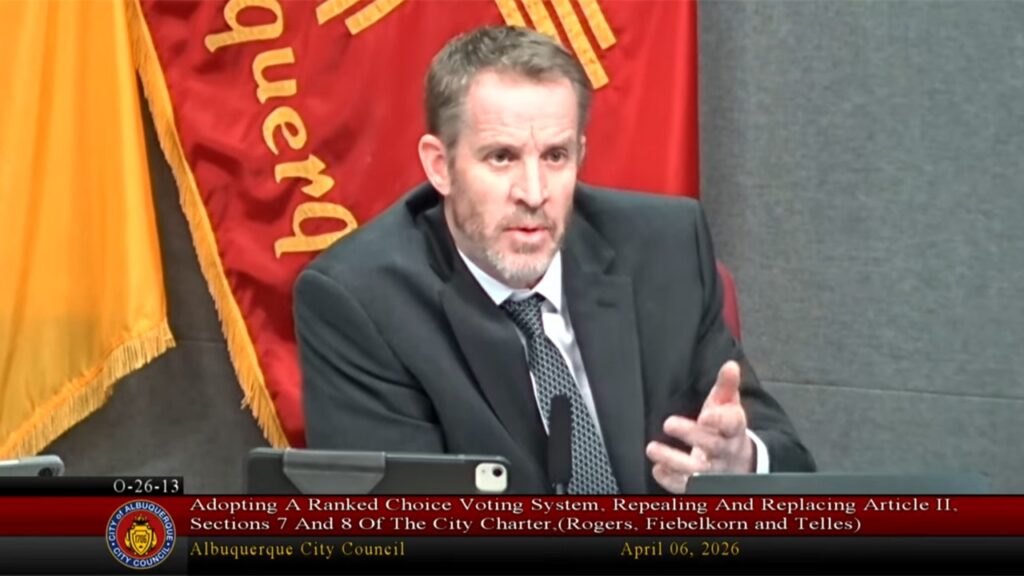
ALBUQUERQUE — The Albuquerque City Council on Monday night rejected a controversial proposal to overhaul the city’s election system with “ranked choice voting,” a move critics slammed as a confusing gimmick that threatens to disenfranchise voters and muddy the clarity of the democratic process.
The measure, O-13, sponsored by progressive councilors Nicole Rogers, Tammy Fiebelkorn and Stephanie Telles, sought to replace traditional runoff elections with an “instant runoff” scheme, failed to gain the necessary support after a marathon session marked by sharp warnings from community leaders and skeptical council members.
Councilor Joaquin Baca, who voiced strong opposition to the change, questioned the fundamental necessity of the reform. “I’m voting for someone based on my values… I’m voting for that person. I’m not choosing my second choice, I’m not choosing my third choice,” Baca said. He noted that, contrary to proponents’ claims of massive voter drop-off in runoffs, the city’s last election saw a turnout decline of less than 4% between rounds.
Critics during public comment echoed these concerns, arguing that the traditional “one person, one vote” system provides a clear, understandable mandate that ranked choice voting (RCV) lacks.
“Ranked choice voting is confusing for voters,” said Paul Gessing, president of the Rio Grande Foundation. “It’s harder for election administrators because special election equipment is necessary… and there’s no way to quickly confirm accuracy of the computer processes involved.” Other residents, like Debbie Reynolds, argued that the current system isn’t broken. “One person, one vote. It’s a simple process and it works,” she told the council.
The rejection follows a growing national trend of skepticism toward RCV. While proponents often market the system as a cost-saving measure, national data suggests significant flaws. According to research from the Heritage Foundation, RCV can lead to “ballot exhaustion,” where thousands of votes are essentially discarded if a voter does not rank the specific candidates who make it to the final tally. In some cases, this allows a candidate to be declared the “majority” winner while actually receiving fewer votes than a traditional runoff winner would require.
Furthermore, academic studies have raised alarms about the impact on minority communities. Research from Harvard’s Ash Center indicates that “ballot exhaustion” occurs at disproportionately higher rates in Hispanic-majority districts, potentially diluting the voting power of the very communities proponents claim to help.
Despite a push from the Bernalillo County Clerk and progressive activists who cited the $1.8 million cost of the most recent mayoral runoff, the council’s majority remained unconvinced that a “numbers gimmick” was the right path for Albuquerque.
The failure of the measure ensures that Albuquerque will maintain its current system, requiring candidates to secure a clear 50-percent-plus-one majority to take office, a standard opponents of RCV say is essential for true accountability and election integrity.