
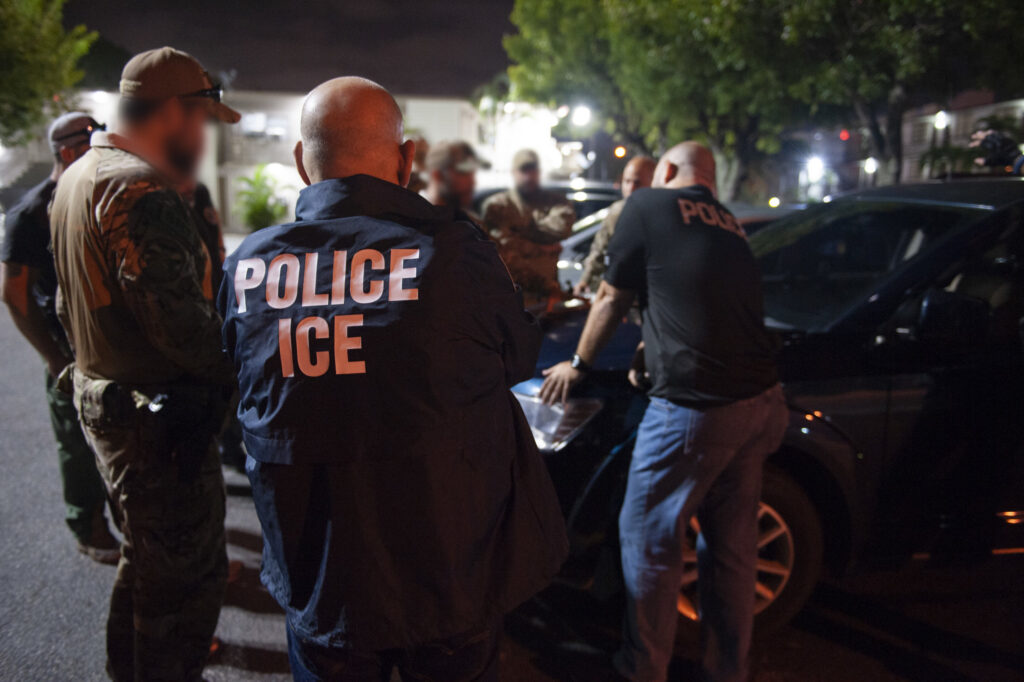
ALBUQUERQUE — The U.S. Department of Justice filed suit Thursday against the State of New Mexico, Gov. Michelle Lujan Grisham, Attorney General Raúl Torrez, the city of Albuquerque, and Mayor Timothy Keller, alleging two recently enacted laws unconstitutionally obstruct federal immigration enforcement — and state officials are vowing to fight back.
The complaint, filed May 8 in U.S. District Court for the District of New Mexico, targets House Bill 9 — the “Immigrant Safety Act” — and Albuquerque City Ordinance O-26-15, the “Safer Community Places Ordinance.” The DOJ simultaneously filed a motion for preliminary injunction to halt both laws. HB9 is set to take effect May 20, giving the court little time to act before the law becomes operative.
The federal government argues HB9 would dismantle decades of voluntary cooperation agreements between local law enforcement and federal immigration authorities — partnerships the DOJ says are essential to enforcing immigration law as Congress intended. Both HB9 and the city ordinance would bar federal agents from using any local government property to conduct immigration enforcement operations.
The Albuquerque ordinance goes further, according to the complaint. By requiring private businesses to alert illegal immigrants to nearby enforcement activity, the DOJ alleges the ordinance effectively functions to harbor and conceal individuals from federal detection — conduct the complaint characterizes as a direct obstacle to federal law.
“New Mexico is attempting to regulate immigration policy, something the federal government is clearly and uniquely empowered by the Constitution to do,” said Assistant Attorney General Brett A. Shumate of the DOJ’s Civil Division.
First Assistant U.S. Attorney Ryan Ellison for the District of New Mexico cited economic and operational consequences alongside the constitutional claims. HB9 would prohibit public entities from participating in federal immigration detention within New Mexico — a restriction Ellison said would put roughly 300 jobs at risk in Otero County. An ICE agent declaration included in the motion warns that closure of the Otero County Processing Center would also strip the agency of nearly 1,000 detainee beds it describes as mission-critical to border region operations.
“HB9 and the SCPO unlawfully interfere with federal immigration enforcement, illegally discriminate against federal operations, and violate constitutional protections regarding contracts and federal supremacy,” Ellison said. “Our lawsuit asks the court to declare these laws invalid and issue an immediate injunction to stop them from being enforced.”
Attorney General Torrez issued a defiant response, calling HB9 a constitutional exercise of state authority and vowing to defend it in court. Torrez argued the Constitution reserves to the states the power to determine how their personnel and publicly funded facilities are deployed, and that the federal government has no right to compel New Mexico’s institutions to administer enforcement priorities the state has chosen not to adopt.
“This lawsuit asks a federal court to override a democratically enacted state law because the administration disagrees with the policy choice the Legislature made,” Torrez said. “That is not a constitutional argument. It is an attempt to use federal litigation to reverse an outcome the administration dislikes. We will see them in court.”
Mayor Keller defended the Safer Community Places Ordinance as a public safety measure. “I will always stand up for the safety, rights, and dignity of Albuquerque residents,” Keller said. “Our policies ensure ALL families can call 911, send their kids to school, and access City services without fear.”
Gov. Lujan Grisham, also named as a defendant, did not issue an independent statement. Her office told KRQE News 13 the state had not yet been served and could not comment directly, but expressed confidence in HB9’s constitutionality.
Not all New Mexico officials backed the state’s position. Albuquerque City Councilor Dan Lewis, a Republican who opposed the ordinance during its passage, said Keller deserves to be sued and called the measure an obstruction of law enforcement. The Republican Party of New Mexico issued a statement calling HB9 driven by partisan politics rather than the safety, stability, and economic well-being of New Mexico communities.
The lawsuit also drew a response from Deb Haaland, a Democratic candidate in the 2026 gubernatorial race, who pledged that as governor she would do anything in her power to stop ICE from tearing families apart, framing the suit as federal overreach into New Mexico’s self-governance.
The case — United States v. State of New Mexico et al., No. 1:26-cv-01471 — is part of a broader Trump administration campaign against sanctuary jurisdiction policies. The Attorney General placed Albuquerque on a published list of sanctuary jurisdictions in August 2025 and pledged litigation nationally. The DOJ filed a similar suit against New Jersey on April 29.
The DOJ noted that the allegations in the complaint are not yet a determination of liability.