
ALBUQUERQUE — New Mexico’s governor and Democratic lawmakers are calling for federal reimbursement and criminal accountability after a whistleblower investigation revealed that U.S. Drug Enforcement Administration agents monitored — but deliberately declined to seize — hundreds of thousands of fentanyl pills entering Albuquerque communities between 2023 and 2025. Republicans, including a congressional candidate with firsthand experience in DEA drug operations, are pushing back hard, arguing the outrage is misplaced.
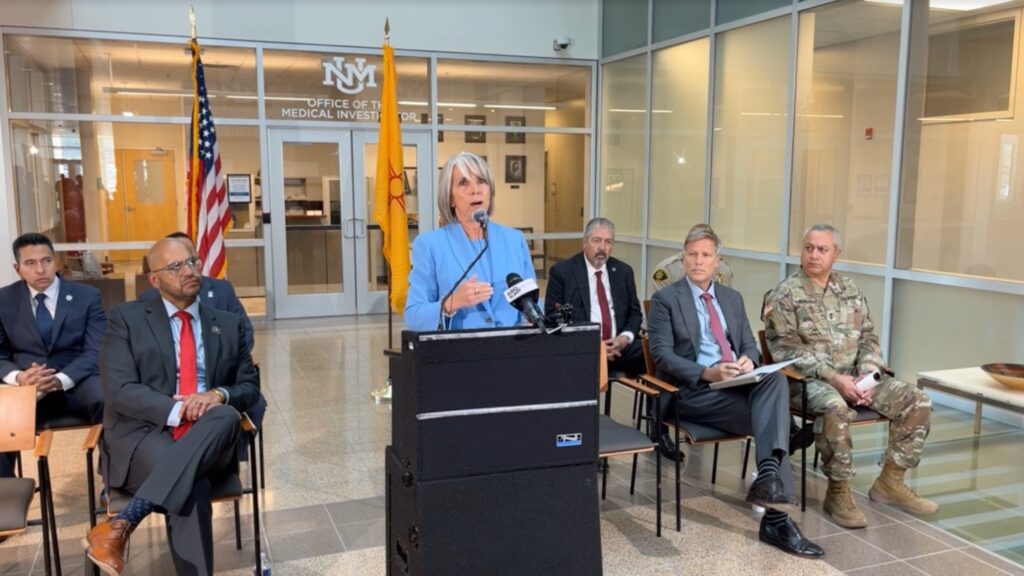
Gov. Michelle Lujan Grisham convened a news conference Monday at the state Office of the Medical Investigator in Albuquerque alongside House Speaker Javier Martínez and Albuquerque Mayor Tim Keller, where she announced plans to seek a White House meeting in the coming days and said the state is weighing legal claims she estimated could reach “hundreds of millions of dollars.”
“I believe the feds have a responsibility — they have to do something about it,” Lujan Grisham said.
The governor also said she would explore legislation to prohibit federal agencies from allowing drug trafficking to continue during active investigations and called on Attorney General Raúl Torrez — who this week launched a formal criminal probe of the DEA — to pursue every available legal remedy.
“New Mexican lives are not the federal government’s cost of doing business,” she said.
Background
The controversy traces to an Associated Press investigation published last week, based in part on a formal whistleblower complaint filed in 2023 by DEA Special Agent David Howell, a 19-year agency veteran working out of Albuquerque.
Howell alleged that DEA agents repeatedly surveilled fentanyl shipments — including a single June 2023 delivery of 74,000 pills to an Albuquerque mobile home park, confirmed later in a federal court filing — and allowed the drugs to reach street-level dealers without intervention. The strategy, according to Howell and other current and former agents interviewed by AP, was aimed at building larger prosecutions against trafficking networks with ties to the Sinaloa Cartel.
Howell reported that agents on the multi-state investigation allowed at least 1.8 million fentanyl pills to go unseized. The operation ultimately culminated in what the DEA announced in May 2025 as the largest fentanyl bust in its history — a seizure of more than 3 million pills in Albuquerque alongside the arrest of 16 suspects.
“We did nothing but sit back and watch,” Howell said. “We 100% got people killed.”
The DEA has denied that agents knowingly endangered communities, saying the investigative decisions were lawful and consistent with Department of Justice guidance. The agency subsequently asked the DOJ’s Office of the Inspector General to conduct an independent review of Howell’s complaint.
The revelations land against a grim statistical backdrop. State Health Secretary Gina DeBlassie said the number of New Mexicans suffering from opioid use disorder nearly doubled in four years — from 44,000 in 2020 to roughly 83,000 as of 2024 — and that the state is on pace this year to surpass last year’s drug overdose death total by 26%, based on preliminary data. While overdose deaths nationwide fell 14% last year, New Mexico recorded a 21% spike.
“No state can be expected to outfund or outwork a crisis the federal government is enabling,” DeBlassie said.
Lawmakers Pile On
House Speaker Martínez, appearing alongside the governor Monday, said the DEA’s alleged conduct had gutted years of state-level investment in addiction and mental health treatment.
“The fact that they allowed hundreds of thousands to flood our streets is unimaginable,” Martínez said. “The federal law enforcement agency that’s responsible for protecting us from dangerous drugs released enough lethal pills to wipe out half of our city.”
New Mexico’s three U.S. House members — Reps. Melanie Stansbury, Teresa Leger Fernández, and Gabe Vasquez — announced a joint congressional investigation and sent a letter to DEA Administrator Terrance Cole requesting a briefing within 30 days on how many times the agency declined to seize fentanyl during wiretap investigations, and what quantities were involved.
Attorney General Torrez, who opened his criminal probe Friday, said his office would demand documents from the DEA both in New Mexico and nationally to determine whether the conduct reflects a broader pattern.
“If those allegations are accurate, the consequences for New Mexicans were not abstract. They were fatal,” Torrez wrote in a letter to the governor.
Not everyone is directing their anger at the DEA.
State Sen. Crystal Diamond Brantley, in a Facebook post Monday responding to the governor’s press conference, called the outrage selective. Noting the DEA conduct occurred under the Biden administration, Brantley accused Lujan Grisham of having refused to deploy the National Guard during what she characterized as Biden’s “open border crisis,” while legislative Democrats “repeatedly opposed tougher penalties for drug traffickers.”
“That’s not leadership. That’s hypocrisy,” Brantley wrote.
Former DEA Task Force Officer Greg Cunningham Pushes Back
The sharpest rebuttal came from Greg Cunningham, a Republican candidate for New Mexico’s 2nd Congressional District and a former DEA task force officer whose background in federal drug investigations gives him direct professional insight into how such operations are authorized and overseen.
Speaking in a video interview posted to Elias Sisneros’ X account Monday, Cunningham said the political pile-on against DEA agents was a deflection from the policy failures he says created the crisis in the first place.
“The narrative that is being presented by my opponent, and by the Democratic side, is in error,” Cunningham said. “What happened here is not a product of what did these agents do or what didn’t these agents do. This is a direct result of the policies that they put into effect.”
Cunningham argued that the conditions enabling mass fentanyl distribution were established by decisions made well above street-level agents: open border policies, sanctuary city designations, and bail reform legislation that he said allowed traffickers to cycle through the justice system without meaningful consequences.
“When you open the border and allow unfettered access from the cartels — when the state of New Mexico does not secure the border, when cities declare themselves sanctuary cities, when you enact policies that do not hold people accountable — you create an environment where things like this happen,” he said.
He also pushed back on the suggestion that field agents were operating independently, noting that DEA operations at the federal level are subject to layered oversight.
“These agents did not make these decisions independently, like cowboys out there on their own,” Cunningham said. “There were people that knew about these decisions. And the politicians that are now clutching their pearls saying, ‘Oh my gosh, what’s going on?’ — no kidding. You’re the bad guy.”
Cunningham directed his sharpest criticism at the governor and Rep. Vasquez, whom he is challenging in the CD2 race.
“The agents are only trying to make lemonade out of the lemons that were thrown at them,” he said. “In this movie, the bad guys are our governor, Gabe Vasquez, and the people that enacted these policies.”
This is a developing story.